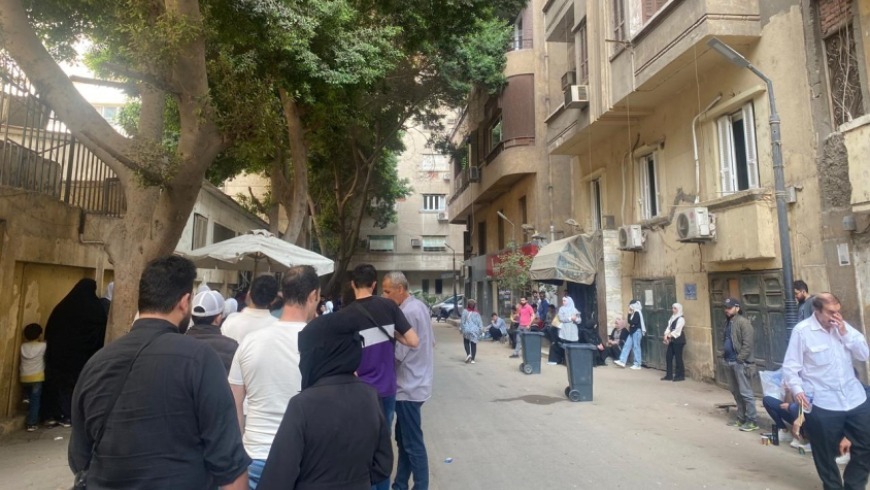
This article explains that since late 2024, the situation of Syrians in Egypt has shifted from a fragile state of administrative tolerance to a systematic policy of pressure. This policy combines restricting residency permits, expanding security-related arrests, and crafting a public discourse that portrays the Syrian presence as an economic and security burden. This has effectively placed thousands of people in an illegal status, imposed upon them by bureaucracy and administrative restrictions rather than by any deliberate violation. I demonstrate that this policy extends beyond mere administrative complexity, encompassing widespread arrest campaigns targeting refugees and asylum seekers, including those registered with the UNHCR. There is documented evidence of systematic targeting, non-implementation of release orders, and the imposition of so-called “voluntary return” under duress, transforming deportation into a disguised form of forced return. I also emphasize that both international and Egyptian domestic law clearly prohibit these practices, and that the international response has remained inadequate given the documented violations, particularly in light of restricted access to detention centers and weak practical protection. The article concludes that Syrians in Egypt are now trapped between deliberately manufactured administrative illegitimacy and a security apparatus that uses it for detention and expulsion, which calls for a clear protection mechanism and an urgent legal settlement of their situation.
______________________________________
Fadel Abdulghany
The situation of Syrians in Egypt has transformed from fragile tolerance to actual persecution. Since late 2024, the Egyptian authorities have pursued a three-pronged policy: administrative restrictions forcing residents into illegal status, unprecedented large-scale security arrest campaigns, and a parallel public discourse portraying the Syrian presence as an economic and security burden.
These aspects together constitute a systematic program that violates Egypt’s binding obligations under international refugee law, human rights law, and relevant treaties.
For years, most Syrians relied on renewable tourist visas as a practical solution, an arrangement that could only have continued with the authorities’ tolerance. However, this tolerance was withdrawn starting in 2024, and residency pathways were limited to a few options, including registration with the UNHCR, study, or investment, without a suitable transition mechanism for those already residing on tourist permits.
The waiting lists at immigration offices now exceed two or three years, and Amnesty International has documented cases where residency renewal dates have been set for 2027 and 2028. The Egyptian Initiative for Personal Rights has described the requirement to pay a fee of US$1,000 and have an Egyptian sponsor as punitive exploitation.
The practical result of this is that tens of thousands of Syrians have become illegally registered, not because of any deliberate violation, but because of a complex bureaucracy that operates according to a mechanism that seems specifically designed to produce this outcome.
Egypt recently enacted an asylum law, but human rights organizations consider it inadequate, as its exceptions related to “national security and public order” are formulated in vague terms without sufficient guarantees for due process. Reliable reports also indicate that the entities involved in current violations will oversee the implementation of the law.
In this context, Egyptian security forces launched an unprecedented arrest campaign that began in the third week of January 2026, and estimates attributed to sources in the United Nations High Commissioner for Refugees indicate that at least 3,000 refugees and asylum seekers were detained during the first two months of 2026.
Field lawyers estimate the number to be between 5,000 and 10,000, while a local Egyptian organization documented about 5,000 arrests in just two weeks. Plainclothes police officers carried out searches in the streets, workplaces and homes in several cities, including Cairo, Giza, Alexandria and Qalyubia.
Even holders of UNHCR-issued yellow cards were not exempt. Checkpoints were also set up near refugee schools and service providers, indicating institutional targeting. A report by the Egyptian Initiative for Personal Rights revealed that authorities issued official police documents containing instructions for the systematic targeting of refugee and migrant communities, elevating this from mere speculation to evidence of a clear policy intent.
The documented pattern of deportation is no less systematic; Amnesty International recorded 22 detailed cases of detention in Cairo, Giza, Qalyubia and Alexandria between late December 2025 and 5 February 2026, fifteen of which were for individuals registered with the United Nations High Commissioner for Refugees.
In 19 other cases documented by Amnesty International, release orders issued by the Public Prosecution were not implemented, and detainees remained in custody without judicial review or the opportunity to challenge the legality of their detention.
The Egyptian Initiative for Personal Rights also documented another aspect of these practices: forcing detainees to sign “voluntary return declarations” under duress and prolonged detention. This practice transforms forced return into a form of deportation disguised as a formal consent.
The UNHCR has explicitly stated its opposition to any forced return of Syrians, and a recently enacted Egyptian asylum law prohibits the deportation of recognized refugees. Nevertheless, deportations continue. The governing legal framework is clear: Article 33 of the 1951 Refugee Convention and Article 3 of the Convention against Torture prohibit refoulement, regardless of an individual’s administrative status.
Article 9 of the International Covenant on Civil and Political Rights, which Egypt has ratified, prohibits arbitrary detention and requires immediate judicial review. The detention of children and the disruption of their education are governed by the Convention on the Rights of the Child, which Egypt ratified without reservation. Article 93 of the 2014 Egyptian Constitution grants international treaties ratified by the state the force of domestic law.
My assessment is that the international response to all of this has been inadequate. The UN Special Rapporteurs sent an official letter to the Egyptian government in December 2025, which the government denied, and then the campaign intensified in early 2026.
The UNHCR expressed concern, but its public response did not reflect the scale of the documented violations. Amnesty International called on the European Union, as a close partner of Egypt on migration and a major donor to the UNHCR, to pressure Egypt to grant the UNHCR access to detention centers and ensure the protection of refugees.
The biggest problem is that denying access to detention centers and border areas severely limits both international and local monitoring, meaning that the documented figures represent a minimum.
Likewise, the Syrian Network for Human Rights called for the signing of a bilateral memorandum of understanding between Cairo and Damascus that would establish mechanisms for consular notification, guarantees against deportation without prior notice, and a framework for settling the status of Syrian residents. In the absence of such a framework, Syrians in Egypt remain trapped between an administrative illegality deliberately imposed on them and a security apparatus that deals with this illegality as a basis for indefinite detention and expulsion.