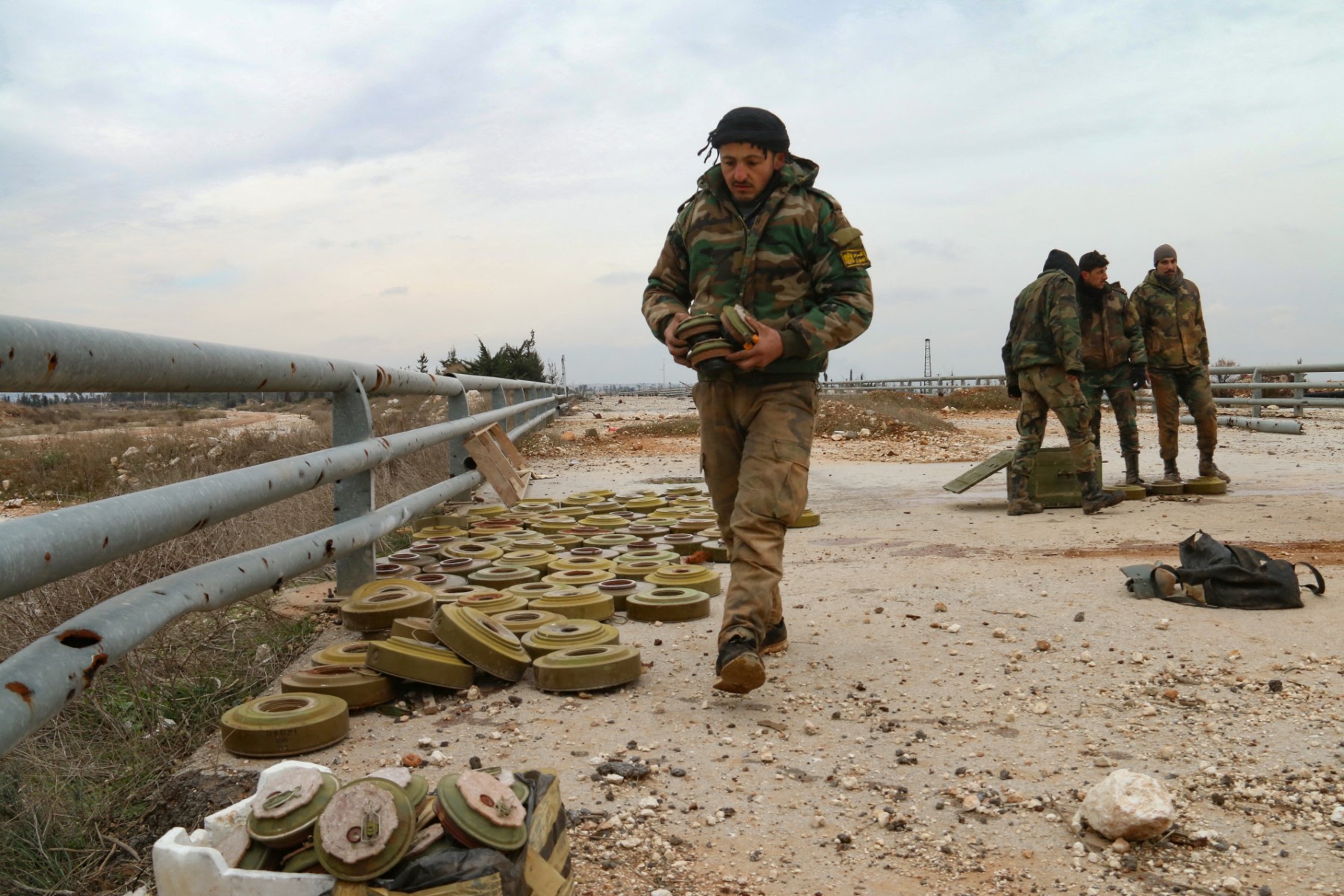
Fadel Abdul Ghani, director of the Syrian Network for Human Rights (SNHR), told The Amargi that the increasing number of deaths is not due to active combat, but rather to the dangers of war remnants, which continue to claim lives. “The act of returning itself has become dangerous,” Abdul Ghani said.
“These weapons were designed to remain active for decades after being planted,” he said. “What Syria is witnessing is an expected result of fourteen years of systematic use by Assad regime forces and Russian forces,” Abdul Ghani said.
The SNHR has documented at least 3,799 civilian deaths from landmines and cluster munitions since 2011 – including 1,000 children. Abdul Ghani stressed that these are minimum figures, as many minefields remain undetected and undocumented.
Since the regime’s fall, the situation has worsened. While displaced people are returning to their villages and agricultural activity is resuming, increasing movement in rural regions, many of these areas were left untouched during the war, meaning the mines were never triggered.
“Civilians are now being exposed to contaminated areas on a daily basis,” said Abdul Ghani. He added that 329 civilians were killed after the regime’s fall, including 65 children and 29 women, in just a few months. As a result, deaths remain high, but now victims are killed by different causes. In 2025 alone, landmines and unexploded remnants killed hundreds of civilians. Some were killed while returning to their homes. Others were plowing fields or searching for truffles.
The SNHR also documented 401 civilian deaths caused by remnants of unexploded cluster munitions. These weapons release smaller sub-munitions over a wide area. Many do not explode on impact, instead lying dormant and effectively becoming scattered landmines.
“These munitions were used in airstrikes on civilian areas… Their widespread and unpredictable distribution makes full documentation impossible,” Abdul Ghani explained.
The geography and identity of victims
According to SNHR, Deir ez-Zor accounts for 23% of casualties, followed by Aleppo and Idlib, each accounting for 19%. These regions experienced the most intense fighting and complex shifts in territorial control during the conflict, leaving behind a deadly legacy of explosive remnants that continue to claim lives even after active combat has subsided.
Children make up approximately 26% of all landmine victims – 862 out of 3,398 deaths caused by mines alone. Abdul Ghani pointed to behavioral and environmental factors: children are less able to recognize danger and more likely to move through open fields and pastures, which are among the most heavily contaminated areas. He called for mine-risk education to be included in school curricula, faster survey and clearance operations, and long-term rehabilitation services for survivors, including prosthetics and psychological support.