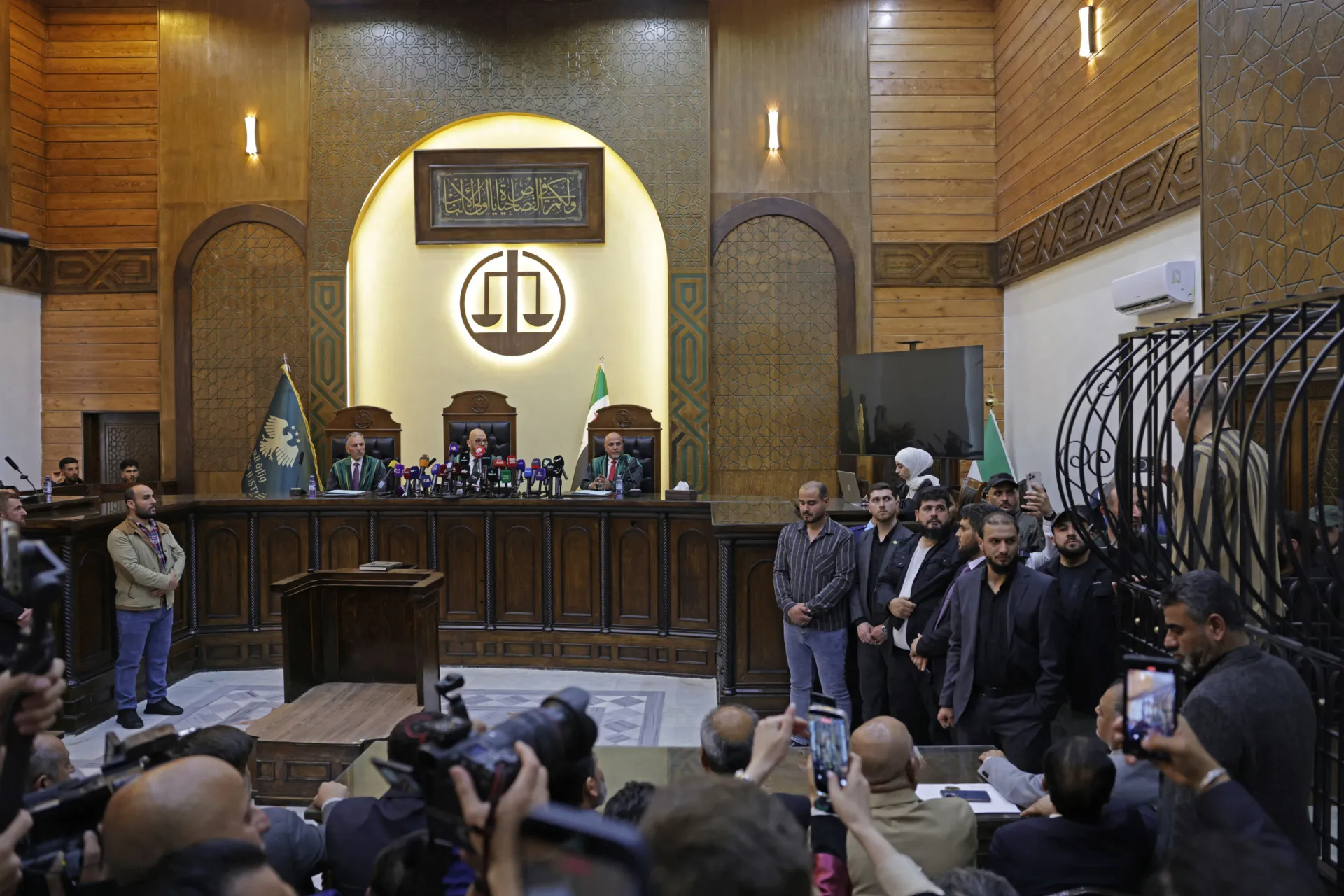
The first criminal trial against a senior official of former President Bashar al-Assad’s ruthless regime is being conducted at a time when the country’s legal framework remains inadequate. Any step toward justice is welcome after a war and accompanying repression that killed an estimated half a million people and displaced millions more. Yet flaws in the trial expose the contradiction between the transitional government’s rhetoric of a Syrian-led accountability process and its refusal to construct the infrastructure that such a process needs. The domestic and international tracks are complementary, but the government’s refusal to pursue both undermines each.
The Syrian Domestic Trial
On April 26, 2026, criminal proceedings opened in the Fourth Criminal Court in Damascus against Brigadier General Atef Najib, a cousin of Assad and until March 2011 the head of the political security branch in the southern Syrian city of Daraa. Other defendants charged in the case, including Bashar al-Assad and his brother, Maher al-Assad, are fugitives.
At the second hearing on May 10, 2026, the court read out at least ten charges against Najib focusing on a period in early 2011 when protests broke out in Daraa. The offenses listed include murder, torture resulting in death, responsibility for massacres, the suppression of peaceful protests, and the torture of minors.
Najib pleaded not guilty. He denied all charges, asserting that he was transferred to a different post on March 22, 2011, and had no authority over other security agencies after that. His defense is contested: the indictment covers conduct beginning in February 2011, before his claimed transfer, and the factual record suggests he exercised command authority over the early crackdown.
Limitations of Syrian Domestic Law
The prosecution is pursuing the case under domestic law. The Syrian penal code prohibits such crimes as murder, torture, assault, and arbitrary detention. Yet prosecutors are also characterizing the offenses as crimes against humanity, citing Articles 12 and 49 of the country’s new Constitutional Declaration. Issued on March 13, 2025, the declaration purports to incorporate treaties ratified by Syria and other elements of customary international law into the national legal system. Article 49 also excludes crimes against humanity and other international crimes committed from the principle of non-retroactivity — but, problematically, only for former regime officials. These constitutional provisions have yet to be formally incorporated into Syria’spenal code.
In addition, Syrian law has no provision for command responsibility – nothing comparable to Article 28 of the Rome Statute of the International Criminal Court (ICC). This gap limits prosecutions to direct perpetrators and effectively shields the chain of command.
The issue of punishment, meanwhile, poses a conflict between the requirements of domestic justice and the possibility for international judicial cooperation. Article 535 of the penal code stipulates the death penalty for premeditated murder, and some of the victims’ families have called for its application. Syria is a retentionist state, and its penal code allows the death penalty for certain grave offenses, including murder, treason, other crimes “against state security,” and broadly conceived terrorism-related crimes.
Under long-established principles, however, European Union member states will not extradite suspects who may face the death penalty, absent highly credible diplomatic assurances that the death penalty will not be applied to the fugitive in question. Many EU states, as well as the UK, will also restrict mutual legal assistance in proceedings where execution is a realistic outcome — effectively foreclosing the cooperation that Syrian prosecutors will need.
In parallel with Najib’s proceedings, the court has proceeded with a trial in absentia of Bashar al-Assad. However, it is far from clear that the authorities complied with Article 14(3)(d) of the International Covenant on Civil and Political Rights, which, while recognizing the right of an accused to be tried in their presence, requires that the accused be formally informed of the charges and of the date of trial.
Assad did not appear in court, appoint a lawyer, or respond to the summons. At the May 10 session, the court declared the absent defendants to be fugitives from justice despite any proof of formal notice to them. Pursuant to Article 322 of Syria’s Code of Criminal Procedure, the court stripped Bashar al-Assad and Maher al-Assad of their civil rights and placed their assets under government administration.
Meanwhile, Assad is in Moscow under Russian protection, and the bilateral framework between Russia and Syria offers no practical pathway for his surrender. In May 2014, Russia vetoed a resolution in the U.N. Security Council that would have referred the situation in Syria to the International Criminal Court (ICC). No subsequent attempt has succeeded in overcoming this impasse. Although Russia is under no legal obligation to cooperate with the ICC, which has already charged President Putin and five other Russian officials for alleged war crimes in Ukraine, the ICC can nonetheless issue arrest warrants for individuals residing in Russian territory, including Assad. That limits suspects’ ability to travel in the 125 ICC member states, as their risk of arrest would be potentially significant. ICC prosecutions also help to establish a permanent record of evidence.
Obstacles to ICC Prosecution
Today, the surest route to ICC jurisdiction over crimes in Syria would be for the new government to join the court and grant it retroactive jurisdiction under Article 12(3) of the Rome Statute, much as Ukraine did to enable prosecution of Russian officials. The ICC chief prosecutor, Karim Khan, visited Damascus in January 2025 and held talks with interim President Ahmed al-Sharaa and Foreign Minister Asaad al-Sheibani. Both the U.N. high commissioner for human rights, Volker Türk, and the head of the International, Impartial and Independent Mechanism, Robert Petit, called on Syria to ratify the Rome Statute.
However, the new Syrian authorities have yet to take this step, largely to avoid exposing themselves and their allies to possible prosecution for crimes committed during their earlier rule as rebel leaders in Syria’s Idlib province. ICC jurisdiction cannot be limited to actors on only one side of a conflict but extends to anyone acting within a designated time frame and territory.
The same political logic shapes the government’s domestic accountability architecture. By Decree No. 20 of May 17, 2025, President al-Sharaa established the National Commission for Transitional Justice (NCTJ), but its mandate is confined to “grave violations caused by the defunct regime,” excluding crimes attributed to other armed groups.
The hostility of U.S. President Donald Trump’s administration to the ICC may also be deterring Syrian action. The U.S. government has imposed sanctions on certain ICC judges and senior prosecutors because of their role in charging Israeli Prime Minister Benjamin Netanyahu and former Defense Minister Yoav Gallant and in allowing a possible investigation of U.S. torture in Afghanistan during the administration of President W. Bush. At a time when one of Syria’s diplomatic priorities is securing sanctions relief from Washington, the new Syrian authorities may not want to be seen as embracing the ICC. Similarly, the Gulf Arab states, whose funding Syria will need for reconstruction, might also view ICC membership unfavorably.
Finally, the transitional leadership has framed accountability as a Syrian-led process, so subjecting itself to the jurisdiction of an external body appears politically difficult for a government that is still consolidating its domestic authority. However, the ICC’s principle of complementarity may offer a way out of this dilemma. By initiating domestic proceedings, the government can claim to be “ready and able” to prosecute and theoretically shield itself from any intervention by the ICC under Article 17 of the Rome Statute. But Syrian authorities will have a more difficult time sustaining a claim that their domestic prosecutions are equivalent to ICC action without more completely incorporating, as described above, international crimes such as crimes against humanity as well as liability doctrines such as command responsibility.
The Way Forward
The European Union has perhaps the greatest leverage to encourage a more productive approach to transitional justice. In May 2025, the EU lifted its economic sanctions on Syria, retaining only arms-related restrictions and targeted measures against former regime figures. On May 11, 2026, the European Council restored full application of the EU-Syria Cooperation Agreement, and the first high-level EU-Syria political dialogue took place that same month. On May 18, 2026, the Council renewed targeted individual sanctions against past regime officials through June 2027 while delisting seven entities, including the Interior and Defense Ministries. With engagement deepening, the EU-Syria partnership framework should now tie further sanctions relief and reconstruction support to clear benchmarks: enacting legislation on crimes against humanity and war crimes, submitting the instrument of accession to the Rome Statute, and expanding the mandate of the NCTJ to include all perpetrators of violations.
The trial of Najib could be a watershed moment in the history of Syrian accountability. However, its transformation into a genuine basis for accountability depends on the willingness of the transitional government to build the necessary legal and institutional framework, not merely to conduct judicial proceedings of limited scope and impact.