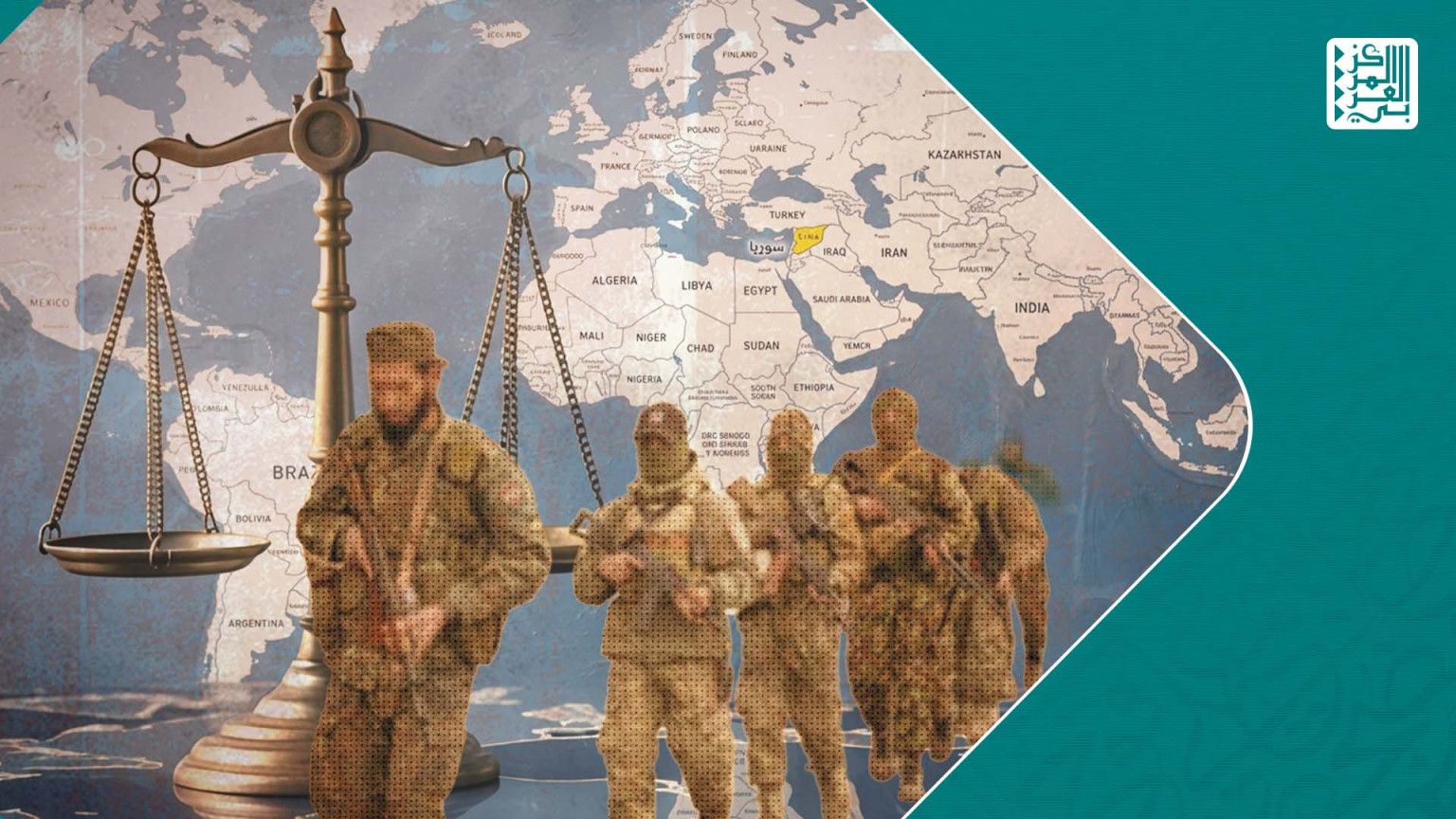
On June 28, 2026, the Arab Center for Contemporary Syria Studies released a new policy analysis, prepared by the Director of the Syrian Network for Human Rights (SNHR), Mr. Fadel Abdulghany, entitled “Between Integration and Accountability: The Legal and Political Architecture for the Management of Foreign Fighters in Post-Assad Syria.” The paper addresses one of the most sensitive files of the Syrian transitional phase, namely the presence of thousands of foreign fighters who did not return to their countries after the fall of the regime, and it warns that their integration into the new Syrian army without vetting or accountability threatens the legitimacy of the security institutions from the very moment of their founding. The paper calls on the transitional government to suspend the unconditional integration of foreign fighters until an independent vetting mechanism is established, and it proposes a three-part architecture that combines a conduct-based legal classification, a conditional integration, and a transitional justice that extends to all parties to the conflict without exception.
The paper takes as its point of departure the events of October 15, 2025, when units of the newly formed Syrian armed forces engaged in their first armed confrontation with Firqat al-Ghuraba, a French-speaking jihadist faction that had refused the call of the transitional government to disarm and to integrate into the national military structure. The confrontation was limited in scope; however, it revealed a dilemma that the international legal order was not originally designed to confront: what happens when foreign fighters who fought in the ranks of a victorious armed opposition do not return to their homelands, at a time where they are not subject to any authority of the state that they contributed to establishing?
The paper argues that the fall of the Assad regime in December 2024 shifted the file of foreign fighters from a counterterrorism problem to a structural challenge within the process of state-building, the reorganization of the security sector, and the tracks of transitional justice. Estimates indicate that around 10,000 foreign fighters, who came from Russia, China, Central Asia, the Balkans, and Western Europe, supported Hay’at Tahrir al-Sham (HTS) and its allied factions over more than a decade of conflict. By the spring of 2025, approximately 3,500 of them had been included in an integration track within the 84th Division of the reconstituted Syrian army. The transitional government, led by the President Ahmed al-Sharaa, proceeded with this integration without rigorous vetting criteria or defined eligibility procedures, and without linking it to transitional justice, while it postponed the question of the nationality and legal status of the fighters in its entirety.
The paper warns against treating foreign fighters as a single bloc. The definition of the “foreign terrorist fighter” that was enshrined by Security Council Resolution 2178 places all transnational fighters in a single counterterrorism category, regardless of the lawfulness of their conduct under international humanitarian law (IHL); therefore, it obscures distinctions that are of significance. Abdulghany identifies at least three categories among those who remained on Syrian territory after December 2024: ideologically motivated jihadists, most of whom come from Central Asia, the North Caucasus, and Xinjiang, and whose units, such as the predominantly Uzbek Katibat al-Imam al-Bukhari and Katibat al-Tawhid wal-Jihad, played operational roles in the final offensive; fighters who joined armed groups without assuming leadership roles and without a credible involvement in violations; and individuals who held administrative or governance functions in areas under the control of armed groups. The paper stresses that any public policy must proceed from the distinction between these cases, and not from a collective classification alone.
As for the existing international frameworks, the paper finds them structurally unsuited to the Syrian scenario. The counterterrorism regime, as it crystallized through Security Council resolutions, is built on the criminalization of travel to conflict zones and on the management of returnees; it does not regulate the transition of foreign fighters into the security forces of a state that has only just emerged from conflict. The approaches of disarmament, demobilization, and reintegration (DDR) presuppose local combatants who have social and territorial ties that facilitate their reintegration. As for the frameworks of transitional justice, in their prevailing Syrian formulation, they tend to confine their attention to the atrocities of the former regime, thus leaving the crimes attributed to foreign fighters allied with the opposition outside institutional jurisdiction or political priority. Hence, Syria faces a compound situation in which foreign nationality, a past or current terrorist designation, and the prospect of absorption into a sovereign security apparatus converge in a single case, without any existing normative framework having been designed for this intersection.
The paper then reviews the comparative record, which offers three patterns of failure that have a direct diagnostic value. The first is integration without vetting, as in Libya after 2011, where the placement of armed groups on the state payroll produced perverse incentives, and ended with the financing of the autonomy of the factions instead of their dissolution into a unified institution. The second is comprehensive exclusion without tracks for reintegration, as in the de-Baathification of Iraq, which turned vetting into a tool of institutional exclusion and generated grievances that fueled armed violence. The third is the separation of DDR programs from the political settlement, which has been widely documented in Afghanistan, where technical programs that were detached from the broader political agreement, and from accountability, lacked legitimacy, local ownership, and sustainability. The paper observes that the risk in Syria is the mirror image of the Iraqi error: not exclusion without alternatives, but a broad integration without guarantees of accountability. In both cases, the structural flaw is the same, namely the treatment of a complex category as a single bloc through a single, undifferentiated track.
On this basis, the paper proposes an architecture that rests on three interlocking pillars. The first is a legal distinction based on individual conduct during the conflict, and not on collective affiliation, which distinguishes, at a minimum, between those against whom credible evidence exists of international crimes (war crimes, crimes against humanity, and torture), those who participated in hostilities without credible evidence of serious violations, and those who held administrative functions. Each category should be directed to its own track: prosecution, conditional integration, or civilian reintegration. The author stresses that this model will produce no effect unless it is operationalized through a national legislation or a clear executive decree that defines the criteria, designates the competent authority, and subjects decisions to review. Equally, the question of the nationality and legal status of the fighters must be resolved as a precondition for integration into the security sector, and not as a consequence that follows it; the current practice of maintaining a non-citizen armed force without a stable legal status is, in the words of the paper, unsustainable.
The second pillar is a conditional integration that is subject to screening and vetting, and to the standards of human rights and of security governance. At the national level, the transitional government should suspend the unconditional integration of foreign fighters into the armed forces until the establishment of a vetting mechanism that meets international standards, that is institutionally independent of the military command, that relies on the documentation held by Syrian and international human rights organizations, and that operates according to criteria defined by law, and not by executive discretion. Those who pass the vetting are integrated conditionally and under continuous monitoring; those who do not pass it are referred to the tracks of accountability or, where appropriate, to supported return programs. At the international level, the paper calls on the United Nations DDR system to develop a specialized operational module for foreign fighters in post-conflict contexts, which addresses the determination of legal status, cross-border cooperation with the states of origin, the interaction between participation in DDR programs and counterterrorism sanctions, and the formal linkage between vetting and the tracks of transitional justice.
The third pillar is a transitional justice that extends to all parties to the conflict without exception, coupled with a structured international cooperation. The states whose nationals fought in Syria are called upon to engage constructively with the transitional authorities in a coordinated determination of legal status, in information-sharing, and in organized return operations. The paper notes that the long-standing refusal of these states to repatriate their nationals has not lost its importance with the fall of the regime; rather, it has become more complex, since some of these fighters are no longer detainees awaiting repatriation, but have become members of state security structures.
The paper concludes by emphasizing that the window available for establishing this architecture is not open indefinitely: every month of unconditional integration without vetting, and every period in which the institutions of transitional justice operate under a selective mandate, entrench institutional arrangements whose amenability to gradual reform is steadily diminishing. The comparative record shows that the errors of the early transitional moment quickly harden into permanent features of post-conflict governance. Abdulghany concludes that Syria is still at a point where these distortions can be corrected; however, this requires decisive institutional choices that are taken before the defect becomes part of the structure itself, since the management of this file will be an early test of the capacity of the new Syria to strike a balance between the need for stability and state-building, on the one hand, and the requirements of accountability and the rule of law, on the other hand.