Fadel Abdulghany
The collapse of authoritarian regimes or the cessation of armed conflicts poses a significant challenge to societies that extends far beyond simply rebuilding physical infrastructure. The social fabric, torn apart by years of violence and repression, requires careful repair through processes that address the legacy of gross violations and pave the way for reconciliation and the restoration of social bonds. Transitional justice provides the legal and moral framework that enables states to address the atrocities of the past, but its success depends, to a large extent, on mechanisms that are often under-researched in academic literature. Among these mechanisms, the press plays a vital and indispensable role. The media uncovers hidden truths, contributes to shaping a collective consciousness that supports accountability, and advocates for institutional reforms that ensure atrocities are not repeated.
The Syrian context offers a crucial case study for examining these dynamics. For decades under the rule of the two Assads, the media landscape was tightly controlled, essentially functioning as a propaganda machine that legitimized state policies and abuses. With the outbreak of the popular uprising in March 2011, a radical shift occurred, marked by the emergence of independent journalistic initiatives and citizen journalism that sought to break the monopoly on information and document widespread violations. This article explores the multifaceted roles that journalism can play in the transitional justice process in Syria, focusing on its fundamental functions of uncovering the truth and confronting cultures of denial. It also addresses the structural challenges facing the Syrian media landscape and proposes practical solutions to enable it to effectively participate in documenting crimes, promoting accountability, and supporting reconciliation efforts.
The concept of transitional journalism refers to the growing role of media in the aftermath of conflicts, wars, or the collapse of authoritarian regimes, as societies strive to achieve transitional justice in its various dimensions. This concept can be understood through two main dimensions: first, the transformation of journalism itself in post-conflict contexts; and second, its close connection to transitional justice mechanisms, serving as a bridge between the past, present, and future.
Media environments in post-conflict countries exhibit varying degrees of fragility in terms of infrastructure, professional standards, and ethics. In such contexts, media outlets are often either complicit with or subservient to the authorities, leading to unbalanced coverage and the marginalization of victims’ voices. At this stage, the media landscape is undergoing profound transformations for several interconnected reasons. The sudden opening of public spaces following the cessation of direct violence or the dismantling of repressive apparatuses encourages the emergence of independent media platforms that strive to provide more objective content, moving beyond the narratives of the former regimes. During this critical phase, media institutions are working to rebuild public trust, which has been eroded by decades of propaganda and coercive censorship.
Given the scarcity of financial and human resources, journalists in post-conflict environments are increasingly turning to digital tools and social media platforms to gather and verify information. This strengthens the role of citizen journalism in filling news gaps, particularly in areas difficult for professional journalists to access. After decades of conflict or repression, there is a pressing need to expose violations, hold perpetrators accountable, and amplify the voices of victims. Transitional media thus serves as a tool for uncovering hidden violence, conveying survivors’ testimonies, and documenting them legally and historically. This type of media transcends the boundaries of simple news reporting, contributing to the shaping of national narratives about the roots of conflict and how to overcome it.
Leading theorists in this field, including Priscilla Heiner in her pioneering work on truth commissions and Martha Minou in her research on responses to genocide and mass violence, emphasize the close link between journalism and transitional justice mechanisms. A free and courageous media is a fundamental pillar upon which societies rely to achieve democratic transformation. This relationship is manifested through four pivotal roles.
First, regarding accountability, truth, and reconciliation commissions, as one of the most prominent mechanisms of transitional justice, the media plays a vital role in conveying the commissions’ recommendations to the public in an understandable language and in covering the hearings of victims and perpetrators. Broadcasting these testimonies contributes to breaking the walls of silence, stimulating collective memory, clarifying the extent of the injustice, and transforming isolated individual experiences into public issues that require a societal and political response.
Secondly, regarding public oversight of judicial proceedings, media coverage enables citizens to follow trials and monitor their integrity, thereby strengthening confidence in judicial procedures and reducing the likelihood of political or military interference. Conversely, the absence of independent media leads to a blackout on court cases and undermines the chances of achieving justice and redress for victims.
Third, transitional journalism and the philosophy of national reconciliation converge by contributing to the construction of inclusive narratives that transcend the divisions left by conflicts. Through platforms for dialogue that bring together victims, witnesses, and experts, the media resist attempts to deny or downplay violations, while simultaneously balancing the need to uncover the truth with the necessity of avoiding inflammatory rhetoric that glorifies violence and fuels divisions.
Fourth, as conflicts end, journalism acquires a special importance in building a lasting collective memory through the systematic archiving of stories, documents, and testimonies, making them available for later use in legal proceedings, historical analyses, and educational curricula. This role goes beyond simply preserving information; it involves reconstructing the human meaning of traumatic experiences, ensuring that the tragedy of the victims is not reduced to cold statistics but rather presented as part of a national narrative aimed at preventing recurrence.
The Historical Transformation and its Analytical Dimensions
Since the Ba’ath Party seized power in Syria in the 1960s, the media landscape witnessed a steadily increasing shrinking of freedoms until they virtually disappeared. Under a repressive legal system, all media outlets (from official newspapers to television and radio stations) became mouthpieces for the Assad regime, subject to stifling security censorship. For decades, the media’s role was confined to glorifying the president and promoting his political discourse, while any attempt to establish independent platforms was met with immediate repression through bans, closures, or security crackdowns.
The outbreak of the popular uprising in March 2011 revolutionized the Syrian media landscape. Independent media initiatives suddenly emerged, and citizen journalism became a revolutionary alternative for conveying the truth. These initiatives utilized social media platforms as alternative channels for reporting events beyond government censorship. These platforms succeeded in presenting a more realistic picture of events, documenting the early days of the popular uprising, and exposing the regime’s repressive tactics. Despite the violent crackdowns targeting citizen journalists and independent media professionals, this new media model continued to expand, benefiting from the digital revolution. Thus, Syria witnessed a qualitative shift from a media space completely closed off to the benefit of the Assad regime to a more pluralistic landscape, even though it remained burdened by security threats, political pressures, and funding crises.
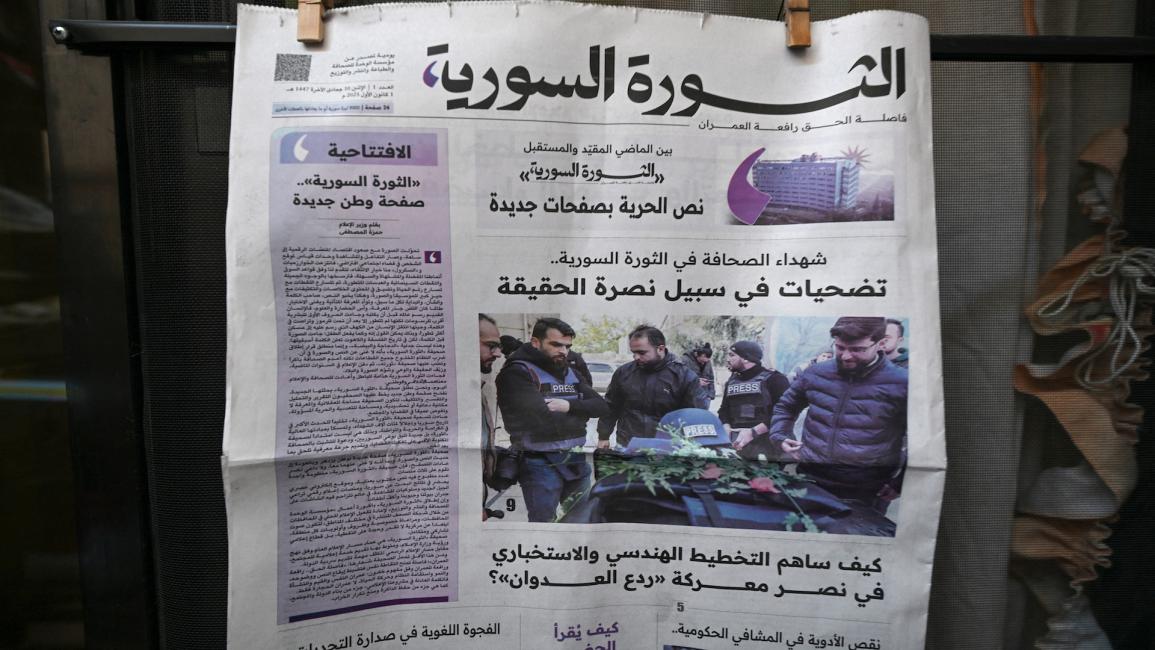
The years of armed conflict have revealed the extraordinary suffering of journalists who paid with their lives for reporting the truth. The early years of the conflict witnessed a sharp rise in systematic violations against media professionals, affecting dozens of independent journalists. From March 2011 to June 2015, the Syrian Network for Human Rights documented the killing of 725 media professionals, 559 of whom were killed by Assad regime forces. At least 486 media professionals, including nine women and 17 foreign journalists, remain forcibly disappeared.
The end of the authoritarian era represents a pivotal historical moment, enabling Syrian society to rebuild democratic structures based on justice and equity. At this stage, five crucial roles for the media become clear. As a custodian of national memory, investigative journalism will have an unprecedented opportunity to complete the documentation of violations, with access to previously withheld documents (such as detainees’ files, secret interrogation records, and military operation orders) that journalists can analyze and verify using advanced digital forensics techniques.
As a vigilant guardian of justice, investigative journalism will play a crucial role in overseeing the reconstruction of judicial institutions by monitoring investigations and trials, and contributing to the identification of perpetrators and their accomplices through the provision of additional, evidence-based information. Furthermore, as a platform for comprehensive national dialogue, post-Assad Syria will witness a massive influx of information and diverse opinions, potentially opening the door to misinformation and inflammatory rhetoric. In this context, the role of professional media in providing balanced content and countering attempts to distort the truth becomes paramount.
As a guardian of the emerging political transition, the media’s role extends beyond exposing past abuses to become the first line of defense against the return of authoritarianism. This is achieved through monitoring the conduct of the new authorities, highlighting violations, raising awareness of human rights values and international conventions, combating hate speech and incitement, and promoting a discourse of equal citizenship and coexistence. Finally, dismantling the discourse of denial remains essential for the success of transitional justice. Continuing to justify or downplay crimes only deepens the wounds of victims and hinders efforts to uncover the truth, while publicly acknowledging violations helps restore dignity to victims and lays the foundation for a more credible reconciliation.
Challenges and Solutions After Tyranny
Syria, emerging from the yoke of tyranny, faces a complex dilemma: how to build a media landscape capable of supporting transitional justice without becoming a tool for division? Legal, institutional, and societal challenges intertwine to form real obstacles to the emergence of a free and responsible media.
Syria has long suffered from the absence of legislation protecting press freedom and guaranteeing its independence. Conversely, the existing legal system criminalizes critical expression while turning a blind eye to incitement to violence and the justification of abuses. This dysfunctional vacuum allows for the manipulation of the media landscape, whether through direct political exploitation or through the invisible pressure exerted by emerging power centers. In the post-Assad era, Syrian media inherited a heavy legacy of corruption, strict censorship, and the destruction of media infrastructure during the years of conflict. This complicates the work of media institutions in fulfilling their intended role of uncovering the truth and promoting transparency. Independent platforms also suffer from funding crises that limit their ability to develop content, train staff, and provide safe working environments.
Furthermore, the years of war revealed deep sectarian and regional divisions, which some media outlets exacerbated by adopting a biased and polarizing discourse. As a result, large segments of the public lost faith in the media in general, hindering the development of inclusive national narratives and undermining reconciliation efforts at their core.
Addressing these challenges requires a roadmap for media in service of transitional justice. Establishing a balanced legal framework necessitates a legislative revolution that redefines the relationship between the media, the state, and society. New laws should guarantee freedom of expression without arbitrary restrictions, while clearly defining the prohibition of incitement to violence or the denial of crimes against humanity. Article 20 of the International Covenant on Civil and Political Rights, which prohibits hate speech that incites violence or discrimination, could serve as a model for new Syrian legislation in this area.
Building the capacity of independent media, through cooperation with specialized international organizations, is a key driver for developing the media landscape. This can be achieved by providing training programs on advanced digital investigative techniques and offering financial grants to independent media institutions, thus ensuring their sustainability and independence. Furthermore, adopting media codes of conduct that establish clear standards for journalistic coverage and reject hate speech, the justification of crimes, and violations of victims’ privacy is an urgent necessity for consolidating journalistic professionalism and ethics.
Cultivating a culture of justice within society requires close collaboration between media outlets and civil society organizations to launch widespread awareness campaigns about the dangers of justifying violations, the importance of fair accountability, and its role in preventing the recurrence of crimes. Developing systems to combat disinformation, through advanced mechanisms for monitoring media manipulation and systematic training programs in digital verification techniques, represents a strategic investment in countering fake news and misleading content that can undermine the transitional justice process. Finally, placing victims at the heart of media coverage means adopting strategies that amplify the voices of those affected and ensure their redress, while avoiding rhetoric that incites revenge or exacerbates divisions, thus ensuring that transitional justice is a restorative, not a vindictive, process.
Conclusion
A fully-fledged transitional justice process is difficult to envision without a free and responsible press. Official institutions alone are incapable of achieving accountability, uncovering the truth, and empowering victims to speak out, let alone facilitating the complex societal dialogue necessary for genuine reconciliation. Striking a delicate balance between freedom of expression and preventing the exploitation of media platforms to promote crimes remains essential. The absence of balanced regulation of media discourse could open the door for instigators to justify the atrocities of war or reproduce the narratives that fueled repression for decades.
Building transitional justice in a country torn apart by years of violence and tyranny is no easy task. However, a free press, adequately protected by law and with sustainable resources, remains a vital safeguard for preserving collective memory and preventing the recurrence of past tragedies in new forms. A society that prioritizes the rights of victims needs a professional and committed media system that operates with integrity, impartiality, and accuracy—a guardian of memory, a witness to the present, and an active partner in building a more just and humane future.