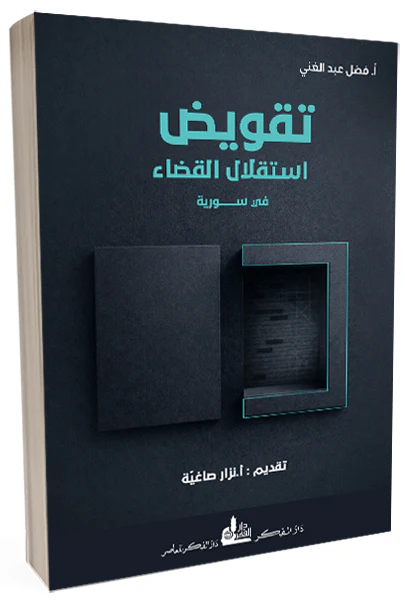
Dar Al-Fikr published the book Undermining the Independence of the Judiciary in Syria under the Assads, Father and Son, and Route to Reform as a comprehensive analytical study into the structure of the Syrian judiciary and the paths of its political and security subjugation over decades. The book is based on the central idea that the independence of the judiciary was targeted through legal and institutional engineering that gradually accumulated until it led to the transformation of the judiciary from an authority that was supposed to protect rights and freedoms into a functional apparatus that serves the logic of political control and weakens guarantees of a fair trial and the rule of law.
The book draws a historical line that shows how the extended state of emergency, the accompanying exceptional legislation and the loose criminalization of state security crimes, constituted an environment conducive to the expansion of the influence of the security services and the marginalization of judicial guarantees. It also addresses the impact of the constitutional structure that granted the executive authority, led by the Presidency, direct and indirect tools to control the judicial authority, through the management of appointment, promotion, transfer, and dismissal, and the resulting weakening of the institutional independence of judges and the establishment of informal oversight of their work.
The book devotes extensive space to analyzing exceptional courts as one of the most important tools for “emptying justice of its content,” highlighting that their nature and procedures – from restricting the right to defense to the absence of procedural guarantees and the weakness or absence of appeal methods – place them in structural conflict with international standards for a fair trial. It also discusses the continuation of the logic of exception in later stages by reproducing it in new frameworks under various titles, including combating terrorism, and what this means in terms of the expansion of the scope of prosecutions and the institutionalization of violations within the justice process itself.
The book does not content itself with providing a “diagnosis” of the judicial crisis, but rather proposes a reform program of a structural nature, based on rebuilding the guarantees that make the independence of the judiciary a practical reality and not just declared texts. At the forefront of these proposals is reforming the Supreme Judicial Council, separating its presidency and function from executive control, protecting the judiciary from tools of administrative and political pressure, abolishing or reducing judicial exceptions according to strict standards, and developing rules and procedures in line with international standards for a fair trial, including guarantees of the right to defense and prohibiting the reliance on confessions extracted under torture. The book also addresses the importance of continuous training and qualification, and the possibility of benefiting from comparative experiences and international technical support without compromising Syrian ownership of the reform path.
This book provides comprehensive knowledge and practical material for those interested in justice reform in Syria: for judges and lawyers, for policy makers, and for researchers in constitutional law, human rights, and transitional justice. It links the independence of the judiciary as a constitutional rule with it being a necessary condition for holding violators accountable, providing justice to victims, building public confidence in the state, and ensuring non-recurrence.
In the Syrian context, the book reminds that any serious path towards moving towards the state of law cannot go beyond asking the judiciary: How was its subordination built? How can its function as guarantor of rights be restored?