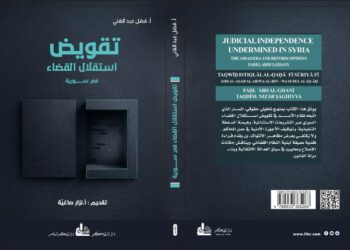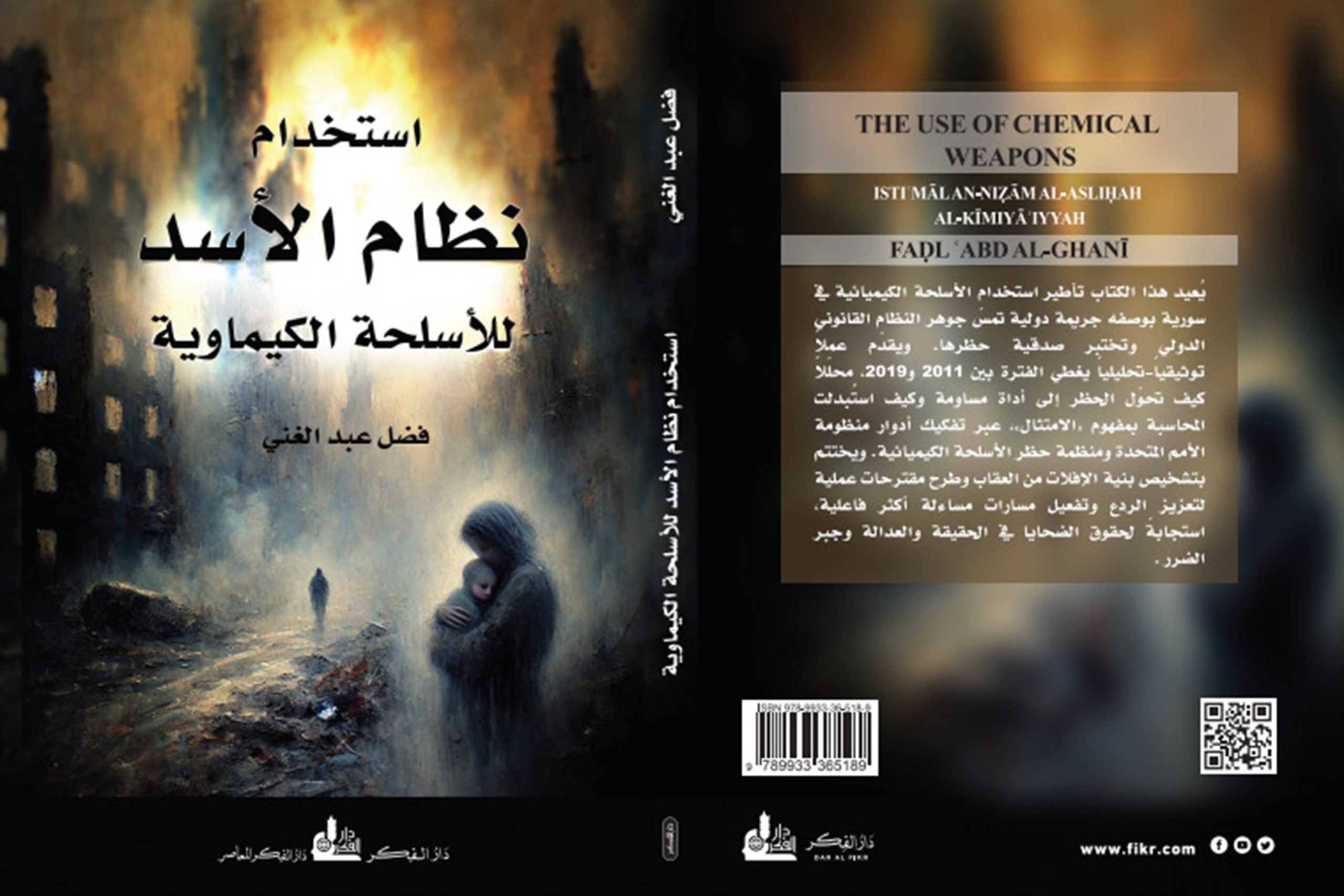
The book The Syrian Regime’s Use of Chemical Weapons in Non-International Armed Conflict & The responsibility of the Russian Protection in the Security Council provides an in-depth legal and analytical reading of one of the most dangerous phenomena of the Syrian conflict: the repeated and systematic use of chemical weapons as a direct challenge to an international ban that is supposed to be one of the most established prohibitions in modern international law.
The author, Fadel Abdelghany, comes from an academic research background. This study was essentially written during the years 2018-2019 as part of the requirements for a master’s degree in international law. The author obtained it in March 2020, and was then drafted into a book issued by Dar Al-Fikr in Syria, allowing it to be transferred from the scope of the thesis to the space of public and legal debate. The importance of the work increases as it seeks to explain “how” and “why” the international system failed to deter the violation or prevent it from recurring, despite the abundance of evidence and the multiplicity of investigation mechanisms.
The book is distinguished by its introduction that places the issue of chemical weapons within a broader context of violations, while highlighting the paradox that has governed the international response: an intense global focus on chemical weapons as a “weapon of mass destruction” with a shocking symbolic effect, compared to a greater deficiency in dealing with widespread forms of killing with conventional weapons. The presentation also highlights the “insidious” nature of these weapons, especially in closed environments (such as basements) where the potential to harm civilians, especially children, is increased. The submission comes with the name Kenneth Roth, which gives the book an additional documentary and legal dimension.
At the methodological level, the author adopts a complex approach that combines the descriptive approach to review relevant international rules, reports, and decisions, the historical approach to trace the sequence of events as they occurred, and the analytical approach to read the interaction between investigations, decisions, and political contexts over time. The book clearly defines its time frame within the period extending from March 2011 until December 31, 2019, years that witnessed a high density of facts and intertwined repercussions on the legal and political levels.
In terms of the research problem, the main question revolves around: Why did the international community and the Security Council fail to deter the Syrian regime from repeatedly using chemical weapons, despite the decisions and reports that proved involvement? It raises questions that affect the credibility of the Security Council, the possibility of replicating the “protection model” by exploiting the veto power, and the need for more effective mechanisms to deter and protect civilians.
The book is divided into three main chapters and a conclusion:
- The first chapter documents and analyzes how UN, international and local investigations contributed to proving the use of chemical weapons, dismantling the roles and mechanisms of the United Nations, the Organization for the Prohibition of Chemical Weapons, and the development of verification and attribution tools.
- The second chapter discusses the impact of international inaction in consolidating the culture of impunity, by tracking major turning points and dividing them chronologically in a way that allows understanding the shifts in the international response and their repercussions on the recurrence of the crime.
- The third chapter presents a structural critique of how international law is emptied of its content when the Security Council is paralyzed, and presents practical recommendations to strengthen deterrence, protection mechanisms, and accountability.
In this sense, the book provides a documentary narrative and a legal-political summary of a severe test to which the regime prohibiting chemical weapons was subjected, and of the limits of the international system when considerations of power and politics prevail over the requirements of law and justice. It is intended for researchers, jurists, policymakers, and anyone who seeks a solid understanding of how the rules prohibiting weapons of mass destruction interact with international investigative mechanisms and Security Council equations, and what is needed to ensure that the ban does not turn into an ineffective text.