Fadel Abdulghany
The principle of separation of powers—executive, legislative, and judicial—is one of the most influential principles in the development of modern constitutional government. Montesquieu systematically formulated this principle in his book “The Spirit of the Laws” (1748), based on the conviction that concentrating legislative, executive, and judicial functions in the hands of one entity breeds tyranny.
However, this principle faces its most severe test during periods of political transition, when societies undergo revolution, regime collapse, or armed conflict. Transitional environments generate structural pressures that tend to favor executive centralization: fragile institutions, contested legitimacy, fragmented civil society, and a growing discourse of urgency used as a convenient justification for suspending checks and balances. Post-conflict and post-authoritarian experiences demonstrate that the erosion of institutional separation of powers during transitions often entrenches new forms of authoritarianism rather than strengthening democratic consolidation. Therefore, understanding why and how to preserve the separation of powers at these critical junctures is both a theoretical and practical imperative.
Theoretical Foundations: Montesquieu, Madison, and the Logic of Institutional Restraint
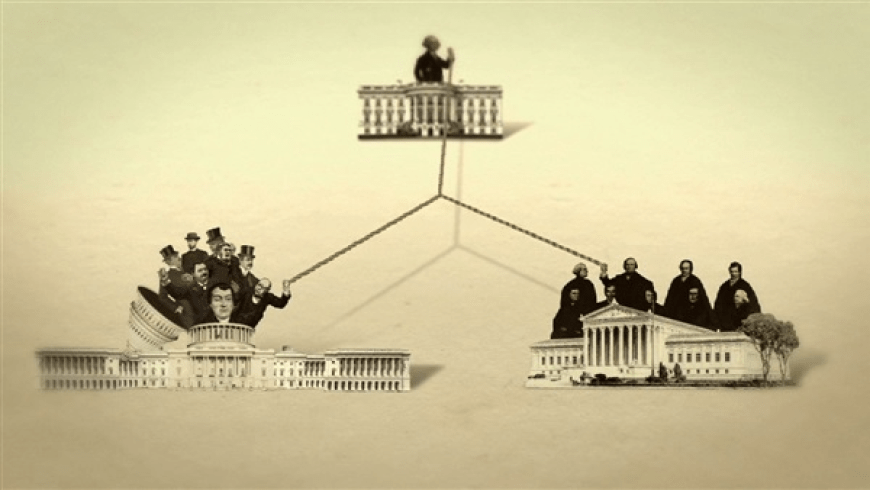
The classical conception of the separation of powers presupposes assigning legislative, executive, and judicial functions to distinct and independent institutions. Montesquieu argued that the concentration of legislative and executive power in a single person or body leads to the demise of liberty, because the same entity that enacts tyrannical laws will also possess the means to enforce them tyrannically. This logic extends to the judiciary; he warned that combining the judiciary with the legislature renders power over citizens’ lives and freedoms arbitrary. This tripartite conception has contributed to shaping the architecture of modern constitutional democracies, particularly in the American model of the Constitution, which distributes power among equal branches and provides them with reciprocal mechanisms for checks and balances.
In the same vein, James Madison, in Federalist Paper No. 48, emphasized the need for practical safeguards for each branch of government against the encroachment of others. The resulting system of checks and balances aims to prevent any single branch from dominating, thereby promoting negotiation, cooperation, and accountability. The essence of this tradition is not merely procedural but also substantive; institutional separation serves as a mechanism to protect individual liberty and prevent the reconcentration of power. Accordingly, this principle also forms the basis for public trust by establishing transparency and horizontal accountability, so that each branch monitors the behavior of the other branches, thereby enhancing the institutional credibility necessary for democratic legitimacy.
The Structural Paradox of Transitions: Why Safeguards Are So Crucial
Political transitions reveal a structural paradox: the very conditions that make checks and balances so urgent are also the ones that make them most vulnerable to disintegration. Post-conflict environments are typically characterized by damaged or nonexistent governmental structures, weak administrative expertise, fragile traditions of the rule of law, and fragmented civil society. In such contexts, the executive branch faces intense pressures and incentives to centralize power, often justified by the necessities of reconstruction, addressing security threats, or the need for swift decision-making.
Comparative constitutional studies in post-conflict states reinforce this dynamic. Experiences from diverse contexts, such as Bosnia and Herzegovina, South Africa, Lebanon, and Uganda, indicate that the concentration of power created by strong executive structures in post-conflict phases has, in many cases, resulted in the formation of dominant governments centered around a single individual or a narrow faction. Crucially, once these structures are entrenched, they become extremely difficult to reverse. It is also noteworthy that this pattern can repeat itself regardless of whether the system is presidential or parliamentary, suggesting that the danger lies not so much in the “constitutional designation” as in the actual distribution of power inherent in the design of institutions.
Contemporary literature on democratic decline demonstrates that “executive overreach” has become one of the most common pathways for the erosion of modern democracies. This occurs through a gradual concentration of power that undermines legislative, judicial, and societal checks and balances via seemingly legal channels. This process takes many forms: diminishing the role of parliament and the courts, legislative domination by a loyal majority, circumventing the opposition through politically motivated referendums, or emptying democratic norms of their substance through elite collusion. Thus, the mere existence of formally separate branches of government is insufficient without genuine institutional independence and firmly established political norms that prevent one branch from dominating another.
The Judiciary and the Legislature: Independence is a Prerequisite for Democratic Transition
An independent judiciary plays a crucial role in political transitions: impartially adjudicating disputes between the state and individuals, curbing excesses of executive power, protecting fundamental rights, and upholding the rule of law. Judicial independence means that judgments are based on legal principles, not on considerations of political influence, which is essential for fostering public trust in the new legal system. In this context, the Constitution Hill Human Rights Precinct’s “Global Guidelines for Supreme Court Appointments” emphasize that one of the central objectives of any political system in transition is to establish an independent judiciary in parallel with the incorporation of new constitutional provisions, because only independent judges can transform the goals of transitional justice—including truth, accountability, and reconciliation—into institutional realities, not mere aspirations.
Comparative experiences reveal a wide range of results: in some cases, the appointment of constitutional judges with high professional reputations and demonstrated independence has helped to create legitimate constraints on governmental power and enforce constitutional requirements, even when this has been politically costly. In other cases, the presence of independent international judges in transitional tribunals has strengthened the capacity to restore constitutional order despite the fragility of the political environment. Conversely, when judicial bodies have been subjected to political purges or have lacked constitutional guarantees and transparent appointment mechanisms, judicial independence has collapsed. This raises a central analytical issue in comparative literature: the distinction between legal (de jure) and de facto independence. Legal texts alone often fail to produce practical independence unless they are underpinned by an institutional culture and effective implementation mechanisms.
The legislative branch faces a similar weakness in transitional environments. In stable democracies, parliament serves as a key institutional check on the executive branch. However, comparative studies show that parliaments in post-conflict phases are often ineffective, regardless of whether the system is presidential or parliamentary. A weak parliament leads to a check on power, allowing authoritarian tendencies to take root. Therefore, strengthening legislative capacities, ensuring respect for term limits, and reinforcing parliamentary oversight mechanisms become essential components of any international support or domestic reform approach. In these regressive phases, parliament sometimes becomes an instrument for consolidating executive power through favorable legislation, weakening the judiciary, and providing political cover for unconstitutional transgressions.
Separation of Powers and Transitional Justice
The relationship between the separation of powers and transitional justice is organically intertwined. The Syrian Network for Human Rights’ vision for the transitional justice process in Syria has emphasized that the work of truth commissions, accountability trials, reparations programs, and institutional reform requires an independent judiciary and an effective parliament. If the courts are subject to the dominance of the executive branch, trials become politicized, and victims’ rights are sacrificed to political expediency. If legislative bodies are weak or sharply polarized, sweeping laws of exclusion or “purging” can be enacted without serious deliberation or sufficient judicial oversight. Therefore, transitional justice mechanisms do not operate in a vacuum; rather, they require the support of broader judicial reform, security sector restructuring, economic reforms, and effective community participation.
The failure to maintain institutional separation of powers during transitional phases has repercussions that extend beyond immediate governance. The concentration of executive power fosters a logic of revenge at the expense of reconciliation, undermines political competition, and erodes the institutional foundation for the peaceful transfer of power. Democratic governance presupposes three independent branches of government: a legislative branch to enact laws, an executive branch to administer and govern, and a judicial branch to adjudicate disputes and guarantee rights. Without this structure, transitions become vulnerable to being seized by dominant factions and lack the institutional basis for sustainable democratic rule.
Empirical research on checks and balances sheds light on this dynamic; some citizens, under the pressure of political gridlock or fear of chaos, tend to favor circumventing institutional constraints, even when the long-term consequences are harmful. This means that the very “transitional mood” can drive increasing executive centralization. Each exceptional expansion of executive power during such periods creates precedents that are difficult to reverse later, as comparative experience consistently confirms.
In conclusion, the transitional frameworks that theoretically advocate separation of powers, while objectively concentrating power in the hands of the executive branch, have revealed a persistent gap between rhetorical commitment and institutional reality. The challenge for transitional authorities, constitution drafters, civil society, and international partners lies in establishing enforceable structural safeguards from the outset, recognizing that the institutional choices made during the transition will shape the subsequent political system.