Fadel Abdulghany is executive director of the Syrian Network for Human Rights and author of The Use of Chemical Weapons in Syria and the Failure of the International Community and Undermining the Independence of the Judiciary in Syria and Pathways to Its Reform.]
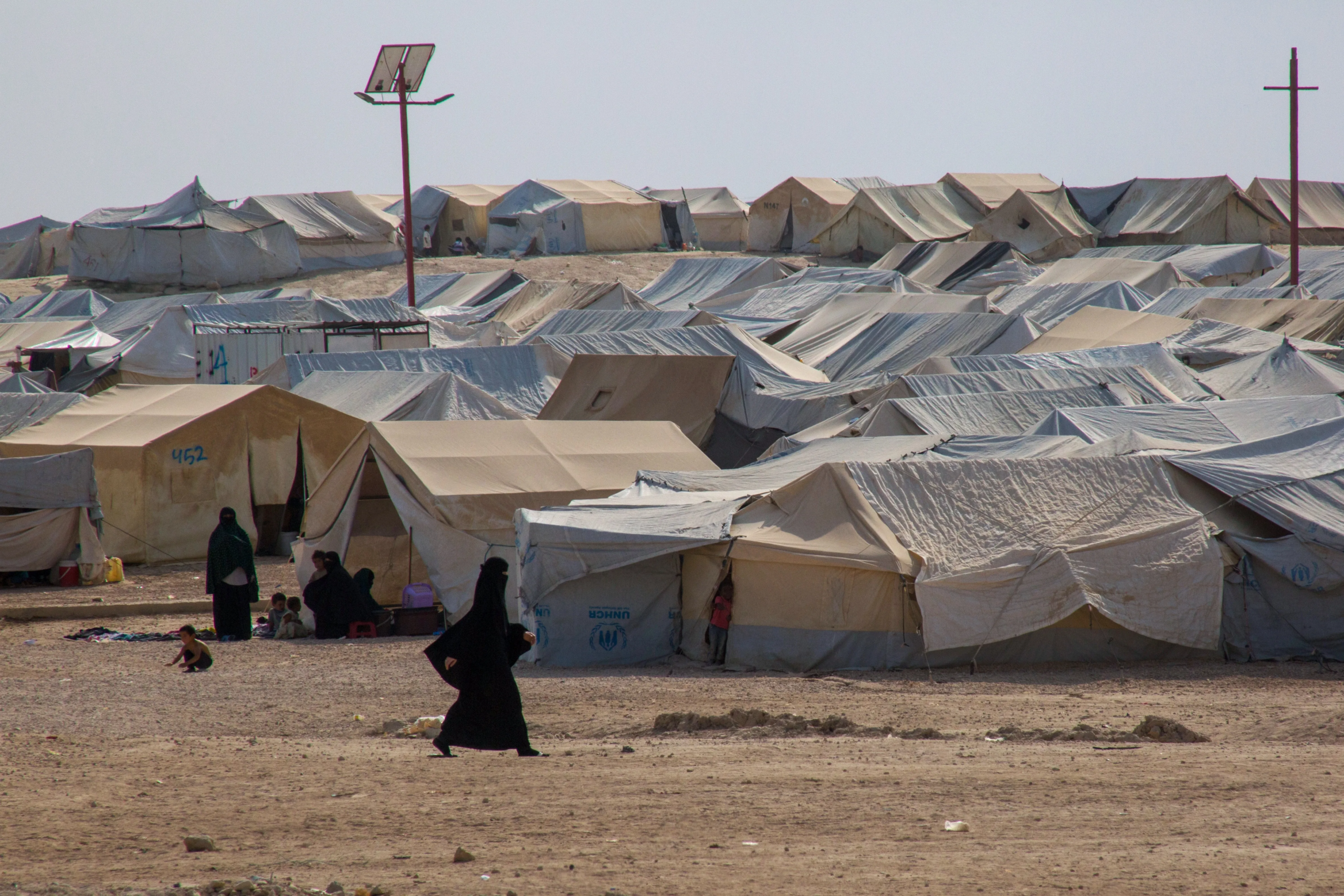
For six years, Al-Hol camp in northeastern Syria was the world’s largest and most troubled detention site linked to the Islamic State and the most turbulent in the world. At its peak, it held some 73,000 people. By late 2025, the population had fallen to roughly 25,000, of whom about 6,500 were foreign nationals from over 40 countries. Children made up more than 60 percent of the residents. Most of the women and children held there were never formally charged with any crime, yet they lived under de facto indefinite detention in conditions that UN experts described as cruel, inhuman, and degrading.
Then, in January 2026, the camp effectively collapsed. The result was the precise catastrophe that human rights organisations, UN bodies, and security analysts had warned about for years. The question now is not whether the international response failed. It is whether states and institutions are prepared to reckon with the consequences of that failure, or whether, as with the camp itself, the preferred response will be to look away.
The sequence of events was swift and chaotic. On January 20, 2026, the Syrian Democratic Forces announced their withdrawal from al-Hol. This withdrawal, which took place without any coordination with the international coalition forces or with the Syrian government, caused thousands of camp residents to flee.
The following day, Syrian government forces entered the camp with armoured vehicles. A government security source declared the situation “fully under control.” It was not. In the gap between the SDF’s departure and the government’s full assumption of authority, thousands of residents were able to escape as administrative control collapsed and camp management mechanisms broke down. Relatives and smugglers arrived at the camp at night, cutting through fencing. Women and chlidren have been transported to safehouses in Aleppo, Raqqa, and Deir ez-Zor.
By mid-February, the high-security annex that had held 6,000 foreign women and children was reported to be “mostly empty.” Jihan Hanan, the former camp director, said she had been told that all residents had “escaped or left.” Save the Children estimated that approximately 70 percent of the camp’s population had departed, with minimal information about where they had gone.
On 17 February, the Syrian government began formally transferring the remaining residents to Akhtarin camp in northern Aleppo province. Officials described the new facility as offering improved conditions, with prefabricated buildings rather than tents, and clean water. Whether Akhtarin will function as a site of rehabilitation and reintegration, or simply replicate Al-Hol’s detention regime under a different name, remains to be seen.
The collapse of Al-Hol did not happen in a vacuum. It was the foreseeable endpoint of a deliberate strategy, one that might fairly be called containment by neglect. For six years, more than 40 states whose nationals were held in the camp refused, in whole or in large part, to repatriate them. The justifications were familiar: national security risks, domestic political opposition, legal complexity. What these justifications obscured was a straightforward reality. States chose to leave their citizens, the majority of them women and children, in indefinite detention in a desert camp rather than absorb the political cost of bringing them home.
That choice was not merely morally questionable. It was contrary to international law at every level.
The right of every individual to a nationality is established under Article 15 of the Universal Declaration of Human Rights and reinforced by the 1961 Convention on the Reduction of Statelessness, which generally prohibits the revocation of nationality where it would render a person stateless. Several states, including the United Kingdom, France, Australia, and Canada, nonetheless revoked or attempted to revoke the citizenship of nationals affiliated with ISIS. The most prominent case is that of Shamima Begum (case commentary), whose British citizenship was stripped in 2019 on national security grounds. Bangladesh has consistently denied that Begum holds its citizenship, leaving her in a legal limbo that the 1961 Convention was designed to prevent. A 2025 independent review urged the UK to reconsider her case and repatriate her, along with other British nationals, from northeastern Syria.
The right of return is established under Article 12(4) of the International Covenant on Civil and Political Rights: no one shall be arbitrarily deprived of the right to enter their own country. The Human Rights Committee has clarified that national security does not provide a blanket justification for denying this right. The legal burden rests on the state. Only the individual may choose not to return.
Beyond these foundational instruments, two binding Security Council resolutions adopted under Chapter VII of the UN Charter created specific and enforceable obligations. Resolution 2178, adopted in September 2014, requires all member states to ensure that persons involved in terrorist acts are brought to justice and to establish serious criminal offences for designated conduct. Resolution 2396, adopted in December 2017, goes further. It calls on states to develop “appropriate prosecution, rehabilitation and reintegration strategies for returning foreign terrorist fighters” and explicitly acknowledges the need to assist women and children who may themselves be victims of terrorism. These are not hortatory recommendations. They carry the force of law under Article 25 of the UN Charter. Yet compliance, particularly among Western states, has been minimal.
The cumulative picture is stark. States were obligated to facilitate the return of their nationals, to prosecute those suspected of criminal conduct through fair domestic proceedings, and to build rehabilitation and reintegration programmes, especially for children. Instead, they did none of these things for six years. The result was not containment. It was incubation.
The position of children in Al-Hol was, and remains, the most morally and legally indefensible dimension of this crisis. Over 12,000 children lived in the camp, many of them born there, possessing no experience of life outside a detention environment. International law is unambiguous that they are victims, not security threats. The Convention on the Rights of the Child guarantees every child’s right to a nationality, to identity, and to have their best interests treated as a primary consideration. The Committee on the Rights of the Child has affirmed the extraterritorial reach of the Convention in the specific context of children detained in northeastern Syria.
European courts have grappled with the implications. In September 2022, the Grand Chamber of the European Court of Human Rights ruled in H.F. and Others v. France that France had violated the rights of French nationals by failing to provide adequate safeguards against arbitrary refusals to consider their repatriation. The Court stopped short of recognising an unconditional obligation to repatriate, but it established that states must examine repatriation requests through a process that provides effective guarantees against arbitrariness. A Brussels court went further, ordering Belgium to repatriate ten children from Al-Hol within six weeks, with fines of 5,000 euros per child per day for non-compliance. A Dutch appeals court, by contrast, ruled that the Netherlands was not required to repatriate approximately ninety children. French administrative courts similarly rejected claims to a right of repatriation.
The legal landscape is thus contested, but the trajectory is clear. The question that remains is how many children will be lost before the trajectory reaches its logical conclusion. The children who departed Al-Hol in January and February 2026, unmonitored, undocumented, and unprotected, face heightened risks of exploitation, family separation, and recruitment by armed groups. These are precisely the outcomes that the Convention on the Rights of the Child, Resolution 2396, and the repeated appeals of the UN Special Representative for Children and Armed Conflict were designed to prevent.
Perhaps the most damaging consequence is the intelligence deficit. UNHCR has emphasised the urgent need for the Syrian government to identify the foreign nationals who left Al-Hol so that appropriate repatriation processes can be pursued. Without documentation or monitoring, many of those who escaped are now beyond the reach of any accountability mechanism. States that refused repatriation on security grounds have, through that refusal, produced the most insecure outcome imaginable: their nationals are dispersed, untracked, and potentially integrated into active extremist networks.
There is also the matter of the approximately 5,700 male ISIS detainees transferred from northeastern Syrian prisons to Iraqi custody in a US-facilitated operation that began on 21 January 2026. Human Rights Watch has warned that these detainees face enforced disappearance, unfair trials, torture, and violations of the right to life in Iraq. Given Iraq’s extensively documented record of due process violations in counterterrorism proceedings, the transfers raise serious questions under the principle of non-refoulement, which prohibits the transfer of individuals to states where they face a real risk of torture. The United States’ role in facilitating these transfers, given the publicly available evidence of Iraqi practices, engages questions of state complicity under the rules of international responsibility.
The Syrian transitional government under President Ahmad al-Sharaa faces a challenge of immense proportions. How will the remaining residents of Akhtarin be treated? Will those not suspected of crimes be free to leave, or will they remain in de facto detention? Will judicial proceedings meet fair trial standards in a country whose justice system requires fundamental reform? Will the ISIS detainee question be integrated into the broader transitional justice framework that the Constitutional Declaration of March 2025 envisages?
These questions cannot be answered by Syria alone. The international community bears a direct and continuing responsibility. States of nationality must immediately repatriate their nationals, particularly children and their mothers, from Akhtarin and wherever else they may be. They must cooperate with Syrian authorities and UNHCR to locate nationals who escaped during the January chaos. They must reverse citizenship revocations that have created statelessness. They must prosecute those suspected of crimes through fair domestic proceedings and develop the rehabilitation and reintegration programmes that Security Council resolutions have required since 2017.
The United Nations must establish a dedicated coordination mechanism for repatriations, restore humanitarian funding that has been devastatingly cut, provide technical support for Syria’s transitional justice processes, and insist on independent monitoring of detainees transferred to Iraq. The Security Council should adopt a new resolution addressing the post-Al-Hol situation with genuine enforcement mechanisms. Six years of binding obligations without enforcement produced the current disaster. Repeating that pattern will produce worse.