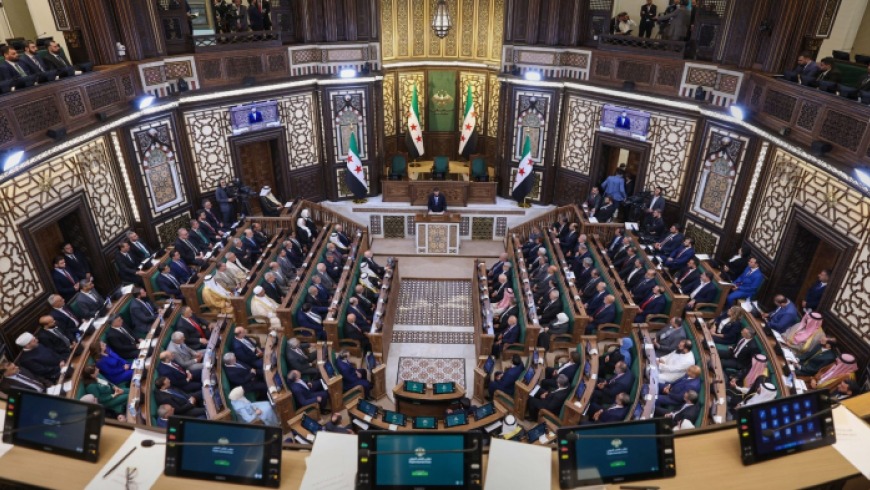
In this article I explain that the fundamental issue facing any transitional legislative council lies in determining the normative basis on which the council relies in laying down those rules. The rules of procedure are not a secondary technical document, since they determine in practice how power is distributed within the council: who sets the agenda, how bills are referred and examined, what rights are guaranteed to dissenting members, how oversight of the executive is exercised, and when recourse to expedited procedures is permissible. And I show that the sound drafting of the rules requires a clear distinction between different sources that must not be conflated: binding constitutional, legal, and human rights obligations, the authoritative interpretations of these obligations, and then the comparative parliamentary expertise and standards which are useful in design, but which don’t become binding rules merely because they are widespread. I also emphasize that the council’s independence in the management of its own business doesn’t permit its rules of procedure to depart from the transitional constitutional framework, or from the fundamental guarantees of rights, participation, and equality. The article addresses a number of practical safeguards necessary to prevent the monopolization of the legislative procedure, or its conversion into a tool in the hands of the presidency or of a temporary majority. Foremost among these safeguards are: entrenching the right of members to access documents and information, protecting their right to object and to record dissenting opinions, regulating the work of the committees and their minutes, guaranteeing the publicity of sittings and votes, and setting narrow and reasoned conditions for recourse to expedited procedures. The article also stresses the necessity of distinguishing between the rules formally adopted by the council, the administrative instructions, the decisions of the presidency, and the informal practices, so that shifting conventions don’t turn into a source of authority that isn’t subject to accountability. And I conclude that good rules of procedure should protect the council from procedural domination as much as they organize its work, and should render the processes of legislation and oversight more transparent, more participatory, and more disciplined. In the transitional period specifically, these safeguards represent a part of building trust in the legislative institution, and in the capacity of the state to manage political disagreement according to declared and fair rules.
Fadel Abdulghany,
The preliminary question facing any transitional legislative council doesn’t concern the rules of procedure that it ought to adopt, but rather the normative authority that empowers it to adopt them. For these rules determine the body that controls the agenda, the speed at which bills proceed, the extent to which minority members are able to obtain documents, the possibility of recording dissenting opinions in the minutes, and whether urgent laws will bypass the procedures of scrutiny. And everything that takes place within the transitional legislature passes, in one way or another, through these rules.
There is no comprehensive international reference for the writing of these rules, and in general, the council must operate within the framework of the binding national and treaty obligations, and within the limits of the transitional constitutional instrument that established it. Thereafter, three types of sources contribute to the shaping of a sound design: binding law wherever it applies, interpretive guidance, including the general comments issued by the Human Rights Committee on the International Covenant on Civil and Political Rights, and the non-binding institutional standards and good comparative practices. These three types shouldn’t be treated as though they were equivalent, because attaching the language of legal obligation to comparative standards distorts their legal status, and weakens the argument for compliance with the rules that are actually binding.
As for the council, it may not treat its rules as free-standing, for they derive their authority from the transitional order, and they must remain consistent with the transitional constitutional framework and with any other instrument to which the applicable legal system grants a higher rank. Parliamentary autonomy usually protects the internal procedures from the direction of the executive, however the scope of this autonomy differs according to the constitutional design, and loose references to this concept often obscure that fact. The rules of procedure should distinguish between the formally adopted rules, the administrative instructions, the decisions of the speaker of the council, and the informal practices, so that practice can’t silently displace the text. They should also provide for a transparent mechanism of interpretation and amendment.
A second structural principle follows from the temporary character of the institution, for the transitional council is a bridge to a subsequent legislature, and not a permanent constitutional end. Its rules should set out the scope of its mandate and the matters falling outside it, should define the relationship between the rules and the political settlement, and should include explicit provisions concerning entry into force, review, and termination. They should also determine how pending legislation and incomplete inquiries are to be handled at the end of the transitional period, and should impose obligations relating to handover and archiving in a manner that ensures continuity with the subsequent body. The burdening of a temporary body with functions that it can’t discharge legitimately or realistically weakens both the transitional period and the legislature that follows it.
One of the most difficult tasks of design lies in the protection against the capture of procedure. The greatest risks lie in control over the agenda, the allocation of debate time, and the classification of bills as urgent. These risks also include committee appointments, access to the information held by the executive, disciplinary sanctions, and the power to amend the rules themselves. Each one of these tools can be used to weaken oversight, pluralism, and accountability if it is left to an unconstrained discretion, in a way that allows those who run the council to hollow out a council that is democratic in its form. Recent comparative work identifies the protection of the foundational rules, the safeguards surrounding fast-track procedures, conflict of interest rules, the rights of the opposition, the opportunities for review, and civic participation, as the foremost procedural safeguards capable of limiting this danger.
It follows from this that the approach taken towards majority rule must be settled. As a general rule, the majority should be able to decide policy, but it may not abolish the procedural conditions necessary for pluralism and accountability. The rules of procedure should distinguish between the rights of members in their individual capacity, the rights of groups, and the rights of the opposition as an institutional actor. For each of these has a different function, since the right of a member to request documents isn’t equal to the power of a minority to compel a recorded vote, and neither of them is equal to the role of the opposition bloc in oversight and in the auditing of the public accounts. It isn’t necessary to adopt a uniform threshold for the exercise of these rights, but rather the thresholds should be proportionate to the function that each right performs.
The ordinary legislative procedures must remain the norm, and the expedited procedures must remain a narrow exception. The 2025 updated Rule of Law Checklist, issued by the Venice Commission, treats the efficient, transparent, inclusive, and democratic enactment of law as a fundamental criterion. It asks whether bills are debated publicly, are supported by adequate justifications, and are made available at a time that permits genuine and meaningful input. It also asks whether urgent procedures are confined to exceptional circumstances, whether late amendments are limited, and whether major reforms and constitutional amendments are excluded from the fast track. And I believe that three matters must be separated analytically here: the continuity of the institution during crises, the acceleration of legislative consideration, and derogation from treaty obligations under Article 4 of the International Covenant on Civil and Political Rights. For the convening of an urgent sitting, or the expediting of the consideration of a bill, doesn’t in itself trigger the application of Article 4, which concerns derogations formally proclaimed under a state of emergency that is publicly declared and that threatens the life of the nation. And the conflation of these three matters blurs distinctions that the transitional order needs to preserve.
The rules should establish a minimum of guarantees of transparency, public participation, and integrity. And since the International Covenant on Civil and Political Rights is binding upon Syria, Article 19 of it, as interpreted by the Human Rights Committee, supports the right of access to the information held by public bodies, as well as the proactive disclosure of information of public interest. The parliamentary standards translate this into a presumption that agendas, bills, committee reports, the minutes of plenary sittings and of committee meetings, voting records, and adopted texts are to be made available, provided that the exceptions are specific and justified, and don’t exceed what is necessary. Public participation should be genuine and accessible, however it must feed into legislative decisions rather than replace the responsibility of the council for taking them. Participation arrangements should also address the equal representation of women in public decision-making, and the availability of participation in political and public life for persons with disabilities. The integrity provisions relating to conflicts of interest, disclosure, and the use of resources fall within the same layer, with the United Nations Convention against Corruption providing the treaty framework wherever it applies.
As for the final analytical point, it concerns the limits of the rules of procedure. The amendment of certain substantive guarantees should be more difficult than the amendment of ordinary procedural details. This is the limited idea of entrenchment, that is, the prevention of a temporary majority from redrafting minority rights, oversight powers, transparency guarantees, and disciplinary procedures, for the purpose of settling an immediate political dispute. And there is no single entrenchment mechanism that is required universally. Nevertheless, the rules of procedure can’t remedy the defects inherent in the establishment of the council under the governing transitional framework, nor can they be a substitute for the independence of the judiciary, or of the security sector, or a free media, or genuine inclusion. These conditions must be guaranteed in the higher framework, and in the process through which the council is formed. So it follows that the rules of procedure regulate the exercise of power, but they don’t create it.