• عربي
Fadel Abdulghany
No Result
View All Result
  • Home
  • BIO
  • Articles
  • Researches
  • Books
  • Quotes to the Media
  • Transitional Justice
  • Interviews
    • Videos
    • Talks and Lectures
  • Home
  • BIO
  • Articles
  • Researches
  • Books
  • Quotes to the Media
  • Transitional Justice
  • Interviews
    • Videos
    • Talks and Lectures
No Result
View All Result
Fadel Abdulghany
No Result
View All Result
Home Quotes to the Media

Rights Group Documents 54 Russian Cluster Munitions Attacks on Syria

21 July 2016
Rights Group Documents 54 Russian Cluster Munitions Attacks on Syria

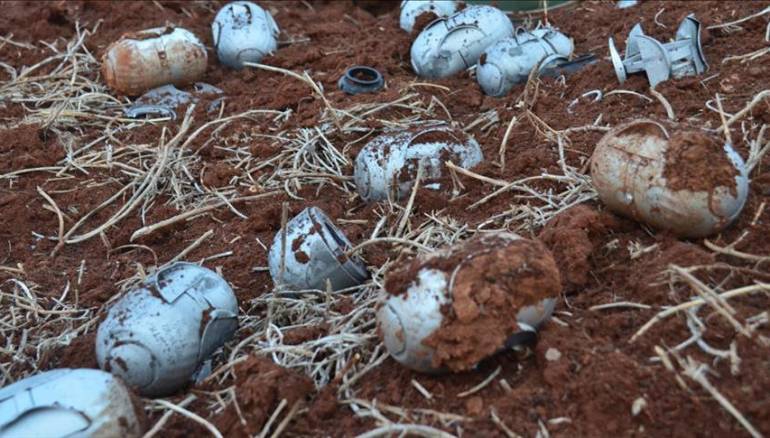
The Syrian Network for Human Rights (SNHR) said that Russian forces carried out no fewer than 54 attacks using cluster munitions on liberated areas across Syria between September 30, 2015, the date of the beginning of Russia’s intervention in Syria, and the declaration of the cessation of hostilities agreement on February 27, 2016. The network pointed out that these attacks have continued even after the signing of the agreement.

In a report issued on Wednesday, the rights group said it collected this data from testimonies of 21 witnesses and survivors of the attacks as well as local media activists.

The SNHR report said that Russian forces carried out these attacks in blatant violation of the resolutions of the UN’s General Assembly which prohibit the use of cluster munitions. The provinces of Idlib and Aleppo bore the brunt of these attacks, according to the report. Nearly 51 of these attacks targeted rebel-held areas in these two provinces, while three attacks targeted ISIS-held areas in the provinces of Deir Ezzor and Alraqqa.

At least 52 civilians, including 13 children and 7 women, were killed in those attacks, while 145 others were injured, the report said.

SNHR Director Fadel Abdul Ghani said that Russia has been using Syrian territory as a testing ground for various types of weapons. The use of cluster munitions in Syria by Russia has not yet been met with any condemnation, he added. Within the period of a few months, tens of thousands of bomblets hit predominantly populated areas in Syria. It will take decades to remove of the remains of these munitions which pose serious risks to civilians, the SNHR added.

Abdul Ghani called on the international community to help the Syrian people neutralize unexploded bomblets by providing all the necessary equipment and expertise.

The SNHR called on the Russian government to immediately stop the use of cluster munitions in Syria. It also called on the UN to investigate Russia’s use of cluster bombs in Syria. The rights group also called on Russia to provide detailed maps of the sites it targeted with cluster munitions in order to facilitate the removal of the remains of these munitions.

The SNHR also called on the Russian government to compensate victims of its cluster bomb attacks in Syria. It called on the UN Security Council to take immediate, concrete action to stop the use of cluster munitions in Syria as well as to hold the Russian government accountable for these attacks. The UN Security Council and the UN Commission of inquiry need to condemn these attacks, the SNHR said. (Source: Syrian Coalition)
Tags: ETILAF
ShareTweetShareSend

Related Posts

The book ” Undermining the Independence of the Judiciary in Syria under the Assads, Father and Son, and Route to Reform” is published
Quotes to the Media

The book ” Undermining the Independence of the Judiciary in Syria under the Assads, Father and Son, and Route to Reform” is published

7 February 2026
How an Assad-era law is threatening Syrian civil society
Quotes to the Media

How an Assad-era law is threatening Syrian civil society

5 February 2026
Survivors Reclaim the Memory of the Hama Massacre
Quotes to the Media

Survivors Reclaim the Memory of the Hama Massacre

3 February 2026
Agreement Between Syrian Government and SDF Leaves More Questions Than Answers
Quotes to the Media

Agreement Between Syrian Government and SDF Leaves More Questions Than Answers

1 February 2026
Photography in Former Detention Centers and Prisons: Who Determines What is Allowed and What is Prohibited?
Quotes to the Media

Photography in Former Detention Centers and Prisons: Who Determines What is Allowed and What is Prohibited?

18 December 2025
Almost a year after Assad’s fall, Syria’s missing remain a deep wound
Quotes to the Media

Almost a year after Assad’s fall, Syria’s missing remain a deep wound

25 November 2025
Tweets by Fadel
Fadel Abdul Ghany

Fadel Abdulghany

Founder and Head of the Syrian Network for Human Rights from June 2011 to date.

Master’s in International Law (LLM)/ De Montfort University/ Leicester, UK (March 2020).

Bachelorette in Civil Engineering /Projects Management / Damascus University.

Recent Posts

  • The Executive Director of SNHR Participates in a Seminar on Transitional Justice in Yemen and Syria
  • The Syrian Regime’s Use of Chemical Weapons in Non-International Armed Conflict & The responsibility of the Russian Protection in the Security Council
  • Undermining the Independence of the Judiciary in Syria under the Assads, Father and Son, and Route to Reform

Quick links

  • Home
  • BIO
  • Articles
  • Researches
  • Books
  • Quotes to the Media
  • Transitional Justice
  • Interviews
    • Videos
    • Talks and Lectures

© 2023 SNHR - Fadel Abdul Ghany.

No Result
View All Result
  • Home
  • BIO
  • Articles
  • Researches
  • Books
  • Quotes to the Media
  • Transitional Justice
  • Interviews
    • Videos
    • Talks and Lectures

© 2023 SNHR - Fadel Abdul Ghany.

Welcome Back!

Login to your account below

Forgotten Password?

Retrieve your password

Please enter your username or email address to reset your password.

Log In

Add New Playlist