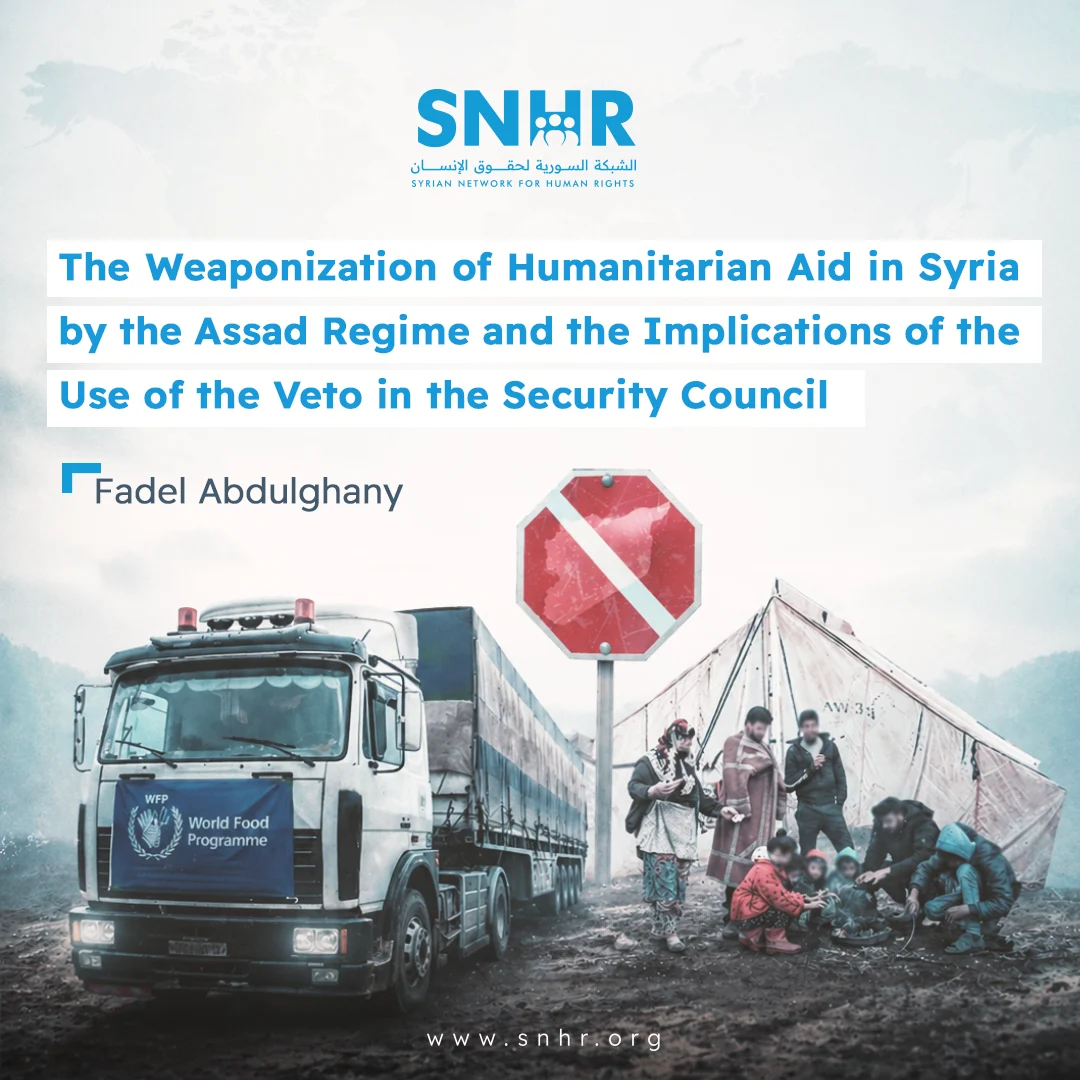
This research demonstrates how humanitarian aid intended for the Syrian people has been transformed from a life-saving necessity into a political instrument leveraged by the Assad regime. It further examines how the repeated use of the Russian-Chinese veto in the UN Security Council has provided international cover for the regime to consolidate this strategy. The study traces the legal foundations for aid access under customary international humanitarian law, the Geneva Conventions, and their Additional Protocols. It analyzes the trajectory of Security Council Resolution 2165 (2014) and its subsequent renewals, documenting its gradual erosion due to repeated vetoes. This process led to the closure of the al-Yarubiyah, al-Ramtha, and Bab al-Salama border crossings, culminating in the expiration of the Bab al-Hawa mandate in July 2023.
The research identifies three primary, interconnected themes:
First, the systematic politicization of aid within regime-controlled areas is manifested in the manipulation of implementing partners, the curation of beneficiary lists, and the diversion of shipments to benefit pro-regime networks. Second, the veto power has been used as an effective tool of deprivation rather than a legitimate safeguard, resulting in food and medical gaps that have disproportionately affected women, children, and displaced persons. Third, the paralysis of the Security Council has had a profound institutional impact on the multilateral UN system, widening the margin of impunity and undermining confidence in collective protection mechanisms.
The research concludes that humanitarian access is a legal obligation, not a sovereign privilege, and that obstructing it constitutes a war crime. It calls for activating the role of the General Assembly, establishing voluntary restrictions on the veto in cases of mass atrocities, and prosecuting those responsible for the obstruction and diversion of aid.
Key Findings
A legal duty to allow access: The Geneva Conventions and their Additional Protocols, as part of the rules of customary international humanitarian law, oblige the provision of prompt, impartial, and unimpeded relief to civilians in need; arbitrary deprivation is unlawful. Chapter VII practice has repeatedly linked large-scale deprivation in armed conflicts to the threat to international peace and security, thereby enabling the Council to take measures to ensure access. Resolution 2165, adopted under Chapter VII, legally authorized the delivery of United Nations aid across borders without Damascus’s consent in order to meet an urgent need to save lives.
The veto as a tool of deprivation: Since December 2019, the repeated use of the veto has resulted in a reduction of the number of authorized crossings (notably the closure of the Al-Yarubiyah and Al-Ramtha crossings in 2020, and then the Bab al-Salama crossing in the middle of the same year), and in July 2023 the United Nations cross-border mandate through Bab al-Hawa expired. These measures led to predictable gaps in food, medical supplies, vaccination campaigns, and the response to the COVID-19 pandemic, with disproportionate harm inflicted on women, children, and the displaced in the northwest and northeast of the country.
State-level manipulation of aid: Within the regime-controlled areas, and in connection with cross-line delivery operations, the regime exercised tight control over implementing partners, approvals, and beneficiary lists; diverted shipments to loyalist networks; and restricted the work of independent non-governmental organizations, reflecting a systematic politicization of relief operations. The study points to evidence of the seizure of a substantial proportion of aid or its rerouting, in a manner that undermines the principles of neutrality and impartiality in its delivery.
The legal effects of obstruction: Invoking sovereignty to restrict life-saving relief is not persuasive under international humanitarian law and the rules of state responsibility when humanitarian necessity is urgent and impartial operations are the only means of avoiding grave harm. Obstruction of relief may rise to the level of a war crime; moreover, the repeated use of the veto in a manner that predictably facilitates such obstruction undermines the third pillar of the responsibility to protect and weakens the structure of collective action within the United Nations.
Institutional erosion and alternatives: The paralysis of the Security Council has damaged its credibility and contributed to expanding the margin of impunity. The study identifies practical, actionable pathways, including grounding cross-border operations in humanitarian necessity when the authorization of the host state or the Council is unattainable; activating the role of the General Assembly, including the “Uniting for Peace” initiative, to recommend the continuation of cross-border aid; and pushing for political and legal initiatives to restrict the use of the veto in mass-atrocity contexts, among them initiatives calling for a voluntary commitment to suspend its use and codes of conduct that strengthen the accountability of those who use it and the scrutiny of every case in the General Assembly.
Conclusions of the Study
- The text affirms that humanitarian access is a binding duty, not a privilege; if the government is unwilling or unable to meet basic civilian needs, or is itself a cause of the deprivation, humanitarian actors may lawfully operate across borders on the basis of necessity, provided that the assistance is impartial and purely humanitarian.
- The use of the veto to cut off humanitarian aid is unjustifiable; the pattern of the veto since 2019 has transformed a preventive instrument into an instrument of deprivation, with the predictable grave harms entailed thereby. This conduct contradicts the purposes of the United Nations Charter in maintaining international peace and security, and undermines global confidence in multilateral protection mechanisms.
- Accountability must encompass the obstruction of aid; any systematic interference in impartial relief — whether by local authorities or through international political maneuvering — must be investigated, and its perpetrators prosecuted, where appropriate, as an international crime.
Recommendations of the Study
Maintain cross-border operations and expand their scope on the basis of humanitarian necessity, while establishing strong and transparent monitoring that ensures neutrality and prevents diversion.
Convene the General Assembly to recommend the continuation of the delivery of cross-border aid, and adopt safe corridors under United Nations supervision wherever the Council is unable to act or is obstructed.
Adopt and activate commitments of restraint in the use of the veto, including (the French–Mexican initiative; the ACT initiative), and implement General Assembly procedures that require public justification and debate after every use of the veto.
Establish an independent humanitarian emergency fund, insulated from political conditionalities, wiThe Weaponization of Humanitarian Aidth effective external oversight, including modern tracking tools, to limit appropriation and ensure allocation according to needs.
Pursue those responsible for the obstruction and deliberate diversion of aid, and formally recognize starvation and the deprivation of relief as crimes warranting prosecution before the competent fora.