Fadel Abdulghany,
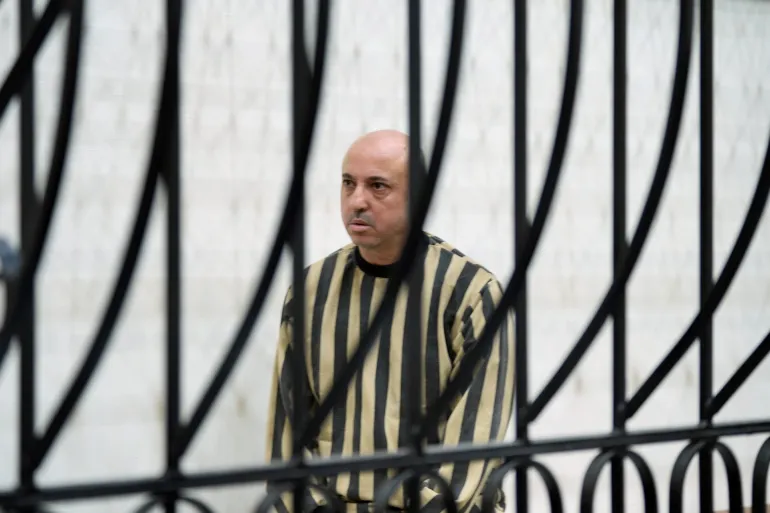
The death sentence issued against Wasim al-Assad by the Fourth Criminal Court in Damascus on 18 August 2026, which is still subject to appeal by way of cassation, carries a great symbolic significance; a member of the former ruling family has been tried in person, and convicted of crimes some of which the court described as crimes against humanity and war crimes.
However, the symbolic weight of this moment shouldn’t settle the central question that transitional justice actually poses, which is the extent to which this trial is capable of performing the functions expected of transitional justice: the establishment of responsibility on legal foundations, the recognition of the victims, and the strengthening of confidence in the rule of law.
The judgment reveals the tensions inherent to any criminal process which follows the collapse of an authoritarian regime, and therefore it ought to be assessed in light of these considerations, and not in light of the political resonance of its outcome alone.
The judgment convicts Wasim al-Assad, according to the court, of premeditated murder, of killing coupled with torture and brutality, of deprivation of liberty, and of related crimes, and it attributes to him the formation of two auxiliary armed groups and the supervision over them, which were active in al-Maliha in Eastern Ghouta between 2012 and 2014.
The court described some of the acts as rising to the level of crimes against humanity and war crimes, while applying penalties prescribed under the Syrian national criminal law.
The court ordered civil compensation for the personal claimants whose claims it accepted, confirmed the attachment of the defendant’s assets, and ordered their confiscation to the benefit of the public treasury after the fulfillment of the civil obligations, and it also referred the decision to the National Commission for Missing Persons in connection with burial sites reported in the orchards of al-Maliha.
The reported use of characterizations drawn from international law, alongside penalties prescribed in the national law, raises a legal question: how did the court connect the underlying facts to the specific national crimes, and to a mode of individual criminal responsibility sufficient to ground the penalty imposed? This question can’t be answered except by returning to the reasoned judgment itself, the publication of which we are still awaiting.
As for the victims, the proceedings acquire their importance on two levels which ought to be separated analytically: the first of them is the function of recognition; the issuance of a public judicial ruling by a Syrian court establishing individual criminal responsibility against a person closely linked to the former ruling family publicly challenges the perception that such proximity to power can place a suspect beyond the reach of the national judiciary.
As for the second level, it is the function of reparation, and the reported measures include a civil compensation for the accepted claimants, the continuation of witness protection after the issuance of the judgment, the preservation of the identities of the protected witnesses in a sealed confidential file, and the referral to the body concerned with missing persons.
These measures may have a direct importance for the victims who are able to participate in the case and for the witnesses who receive protection, however they don’t constitute a substitute for a comprehensive reparations program.
Comprehensive reparation includes restitution, rehabilitation, satisfaction, commemoration, and guarantees of non-repetition, and it extends as well to victims who were never parties to a particular criminal case.
The contribution of the case to the path of transitional justice depends on whether the reasoned judgment, the evidentiary record, and the outcome of the cassation appeal will be made available, with due regard to the restrictions necessary for the protection of witnesses, in a form that enables future proceedings against other defendants to build upon them, and without that, the case is likely to remain a limited instance of individual accountability, rather than providing a reliable foundation for a coherent path.
As for the soundness of the proceedings from the legal standpoint, it is the place where the theoretical stakes reach their peak, for Syria acceded to the International Covenant on Civil and Political Rights in 1969, and Article 6 (2) confines the death penalty to “the most serious crimes”, an expression which the Human Rights Committee interprets narrowly, so as to cover only crimes of extreme gravity involving intentional killing, provided that the penalty is imposed under a law which was in force at the time the crime was committed, and on the basis of a final judgment rendered by a competent court.
General Comment No. 36 further provides that a violation of the fair trial guarantees stipulated in Article 14 renders any death sentence resulting from it arbitrary and in breach of Article 6.
The discussion isn’t confined to the fulfillment of the minimum procedural guarantees, but it extends also to the question of whether the death penalty is necessary in the first place for the achievement of accountability for the gravest crimes.
Thus, the International Criminal Court, which has jurisdiction over the crime of genocide, crimes against humanity, war crimes, and the crime of aggression, doesn’t permit under Article 77 of the Rome Statute anything other than penalties of imprisonment, including life imprisonment in exceptional circumstances, alongside fines and forfeiture.
This doesn’t mean that Syria, as a State not party to the Second Optional Protocol to the International Covenant on Civil and Political Rights, is prohibited from retaining the death penalty in its national law, and Article 80 of the Rome Statute likewise doesn’t affect the application of penalties prescribed in national laws.
However, that does show that accountability for the most egregious crimes can be achieved without recourse to execution, and that the legitimacy of the transitional process isn’t measured by the severity of the penalty, but rather by its capacity to establish individual criminal responsibility within the framework of a fair trial, to safeguard the rights of the defense, and to enable the victims to participate and to obtain a meaningful reparation.
This orientation is reinforced by the United Nations General Assembly resolution 79/179, which called upon the States that have not abolished the death penalty to establish a moratorium on executions and to reduce the scope of its application, even if the resolution remains legally non-binding.
As for the theoretical thesis around which these observations are organized, it is that the issuance of a death sentence against a person close to the former ruling family doesn’t satisfy, in its substance or in its symbolism, the obligations of the State in the field of transitional justice.
So it follows that these obligations are procedural as much as they are substantive, and any proceeding which doesn’t withstand an independent scrutiny of its evidentiary basis, of the guarantees of the rights of the defense, and of its legal reasoning, risks weakening the claims associated with the rule of law within the framework of transitional justice, rather than strengthening them.
Hence, the ultimate significance of this case for the path of transitional justice in Syria will depend less on the severity of the penalty pronounced on 18 August 2026, and more on the integrity of the proceedings, the quality of the reasoned judgment, the fairness of the cassation review, and the provision of meaningful remedies for the victims.