Fadel Abdulghany
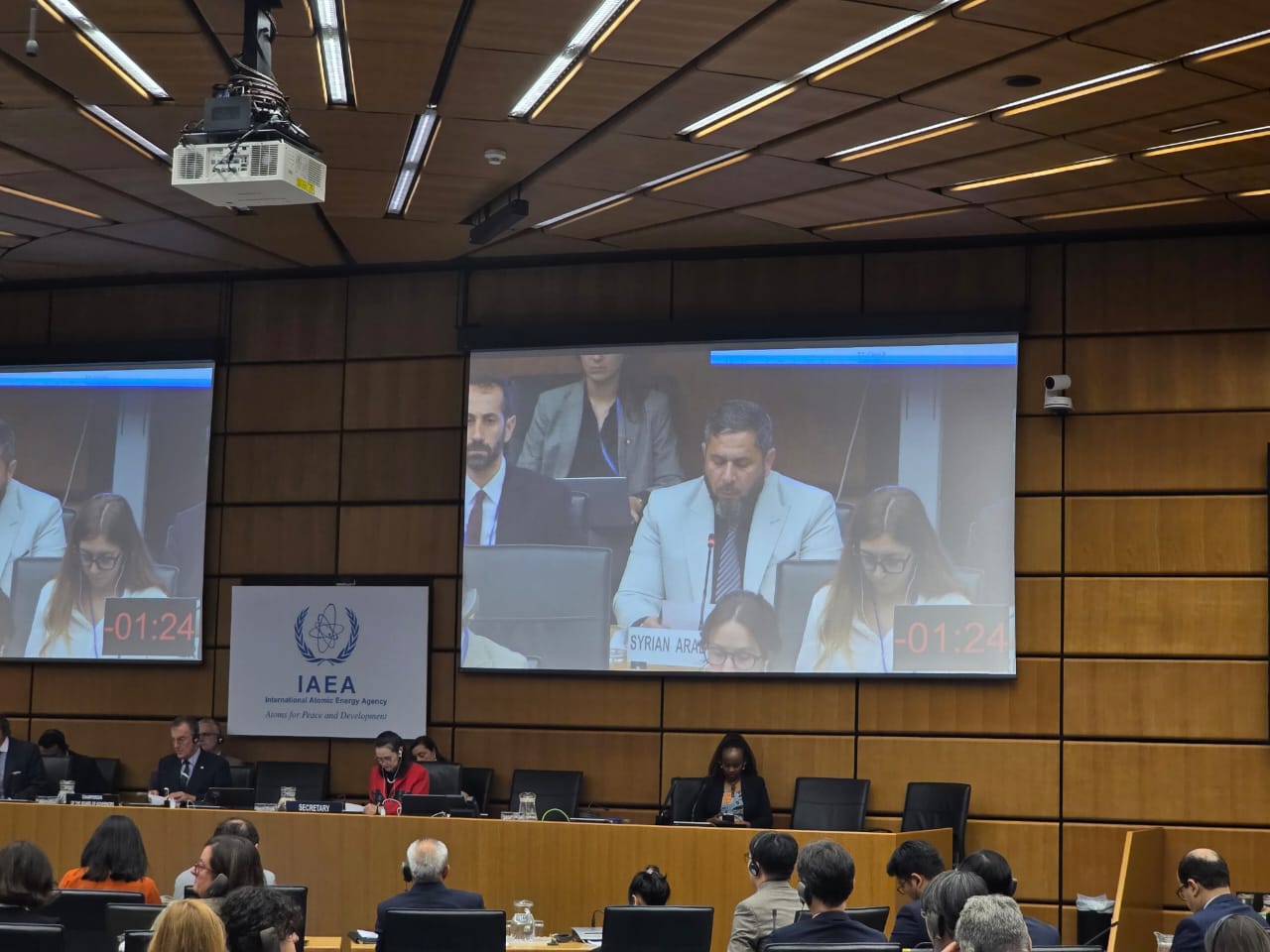
The decision of the Board of Governors of the International Atomic Energy Agency (IAEA), issued on 9 September 2026, lends itself to two mistaken readings, each of which obscures its legal structure. The first reading treats it as a closure of the Syrian nuclear file, whereas the second plays it down as a procedural adjustment devoid of substance.
Both readings fail, however, because they blur a distinction on which the whole of the analysis is built, namely the difference between settling the specific safeguards non-compliance case, which was formally before the Board, and settling the history of the former Syrian nuclear program. The Board accomplished the first. As for the second, it didn’t accomplish it, nor could it have done so in light of the available record. Understanding the decision therefore requires keeping these two questions separate.
In 2011, the Board of Governors concluded, in document GOV/2011/41, that Syria was in non-compliance under Article XII.C of the Statute of the IAEA, on account of the construction of an undeclared nuclear reactor in Deir Ez-Zour and the failure to provide the required design information.
This Article doesn’t make non-compliance a permanent legal attribute of the State, in a manner resembling suspension of membership or expulsion. Rather, it attaches to the breach a set of institutional consequences: calling upon the State to remedy it, reporting it to the member States, to the Security Council and to the General Assembly of the United Nations, and the possibility of further measures if corrective action isn’t taken. What the September 2026 decision did was to bring to an end the exceptional framework that had remained in place as a result of that finding, after the Board considered that the matters on which it rested had been addressed.
As for the obligations that remained in force, Syria’s Comprehensive Safeguards Agreement, INFCIRC/407, remains applicable for as long as Syria is a party to the Treaty on the Non-Proliferation of Nuclear Weapons, and its provisions on design information, material accountancy, reporting and inspection remain in force without exemption. The placing of the uranium under safeguards, the continued accountancy and monitoring of the material, and the conduct of further verification work in Deir Ez-Zour all rest on a safeguards relationship that never ceased to bind Syria, even if some of these activities represent specific follow-up measures arising out of the former program.
Beyond the law of safeguards, the decision raises a broader question relating to the continuity of the obligations of the State after a change of government, so the political change that took place after the fall of Assad doesn’t mean a change in the legal personality of the State itself. The settled rule is that a change of government doesn’t alter the treaty obligations of the State. The political responsibility of the former officials, however, and any individual criminal responsibility, remain two separate questions.
The remediation acknowledged by the Board rested on a reconstruction of the facts far stronger than what was available in 2011. According to the confidential report of the Director General, as described in the official statements of the Board and as seen by international news agencies, the investigators identified around 73 tonnes of natural uranium that had not previously been declared, some 55 tonnes of which were in the form of fuel rods, alongside a gas-cooled, graphite-moderated reactor resembling the Yongbyon design, a facility dedicated to fuel fabrication, a separate storage site, and planning connected to reprocessing.
The 2011 record was already strong, since it rested on imagery, environmental sampling, procurement information and technical analysis, but the subsequent cooperation of the current Syrian government turned a great deal of those technical forensic inferences into documented detail.
The public reservation expressed by the Director General of the Agency defines the limits of what these facts establish. The configuration of the reactor establishes the potential relevance of its design to weapons manufacture, and the capability it could have provided had its operation been completed, but it doesn’t establish the existence of an intent to build weapons. Nor does the record show the existence of separated plutonium, or an operating reprocessing program, or a decision by the former regime to build a weapon.
Capability and intent, therefore, are two different conclusions, and the evidence reaches only the first. There is also an institutional limit here, for the Comprehensive Safeguards Agreement is designed to verify compliance with the obligations to declare nuclear material and not to divert it, and isn’t a general mandate for intelligence work or criminal investigation.
The politics surrounding the decision are consistent with this legal structure. Consensus, in itself, was not legally required, since the ordinary decisions of the Board are generally taken, under Article VI.E, by a majority of the members present and voting. Its significance lies rather in the political dimension, for the adoption of a draft resolution under Arab sponsorship made it possible to present the normalization of Syria’s treatment within the safeguards framework as a recognition of a remediation that had been verified.
The restoration by the Organisation for the Prohibition of Chemical Weapons (OPCW), in July, of Syria’s rights points to a similar institutional logic in the post-Assad phase, even if this came about through a different legal mechanism, which I discussed in an earlier article. The OPCW restored rights that had been suspended since 2021, whereas the IAEA brought to an end a non-compliance case in which membership rights had not been suspended in the first place. What the two cases have in common is the tendency to distinguish between the treaty obligations and the legal personality of the State on the one hand, and the conduct of the government that was previously acting in its name on the other.
Thus the distinction that governs the analysis holds across the various dimensions of the decision. What came to an end on 9 September is a specific non-compliance track that lasted fifteen years, and with it the pattern of exceptional oversight that was tied to it. By contrast, the historical breach has not been erased, and Syria’s obligations under the safeguards regime have not come to an end. The decision shows how an international organization was able, in this case, to preserve the continuity of the obligations of the State, and at the same time to distinguish between the violations of the former Assad regime and the cooperation of the current Syrian authorities.
The significance of this track lies in the way the legacy of the former regime was dealt with: not through a denial of the violations that occurred, but through cooperation, through making information and sites available, and through enabling an independent and specialized international body to carry out the verification itself. In this sense, the decision represents an important step in reordering Syria’s relationship with the institutions of international monitoring on a basis of compliance, cooperation and verification.