• عربي
Fadel Abdulghany
No Result
View All Result
  • Home
  • BIO
  • Articles
  • Researches
  • Books
  • Quotes to the Media
  • Transitional Justice
  • Interviews
    • Talks and Lectures
    • Videos
  • Home
  • BIO
  • Articles
  • Researches
  • Books
  • Quotes to the Media
  • Transitional Justice
  • Interviews
    • Talks and Lectures
    • Videos
No Result
View All Result
Fadel Abdulghany
No Result
View All Result
Home Quotes to the Media

The Executive Director of SNHR Fadel Abdulghany Meets the President of France and the French Foreign Minister in Damascus

9 July 2026
The Executive Director of SNHR Fadel Abdulghany Meets the President of France and the French Foreign Minister in Damascus

Damascus – The Syrian Network for Human Rights

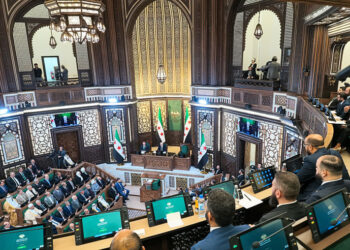
Upon an invitation from the French Ministry of Foreign Affairs, Fadel Abdulghany, the Executive Director of the Syrian Network for Human Rights (SNHR), participated on Tuesday, July 7, 2026, in a meeting that brought together the French President Emmanuel Macron with a number of representatives of Syrian civil society organizations in Damascus.

During the meeting, Abdulghany presented the vision of SNHR regarding the institutional challenges facing Syria in the transitional phase, stressing that the country is passing through a pivotal stage that requires a sustained international support that helps it rebuild public institutions that are professional, independent, and subject to the rule of law.

He clarified that the current challenges aren’t limited to the effects left behind by the years of armed conflict; rather, they are also linked to a long legacy of weakening the state’s institutions, undermining their independence and competence, and subjugating them to political loyalty at the expense of the law and the public interest, practices that had begun before 2011 and worsened catastrophically over the subsequent years.

Abdulghany called on France to continue its support for the Syrian people and civil society institutions, and to contribute to long-term programs for the reform of the justice and law enforcement sectors, provided that this support is built on the respect for human rights, institutional independence, transparency, oversight, and accountability.

Abdulghany pointed out that the international support for these institutions shouldn’t be limited to the provision of resources and training; rather, it must include a structural reform based on the assessment of competence and integrity, and fair individual vetting procedures that exclude those whose responsibility for gross violations is proven, with respect for legal guarantees and the individuals’ right to appeal.

He added that the reform of institutions constitutes a fundamental element of the guarantees of non-recurrence of violations; however, it cannot be a substitute for the rest of the transitional justice paths, including truth-seeking, accountability, reparation, memorialization, and the participation of the victims and their families in the design of the new policies and institutions.

He stressed that the international support programs must be built on national ownership and the effective participation of civil society organizations, victims, and women.

He clarified that the reform of the justice and law enforcement sectors in Syria needs considerable financial and technical resources, as well as long-term programs for training, capacity building, and the restructuring of institutions, noting that the available national capacities aren’t sufficient on their own to meet all the requirements of this process without a serious and sustained international cooperation.

Source: Syrian Network for Human Rights
ShareTweetShareSend

Related Posts

Ali Kayali, Main Suspect in 2013 Baniyas Massacre, Arrested
Quotes to the Media

Ali Kayali, Main Suspect in 2013 Baniyas Massacre, Arrested

15 October 2026
Israeli forces killed at least 69 people in southern Syria since fall of Assad
Quotes to the Media

Israeli forces killed at least 69 people in southern Syria since fall of Assad

8 October 2026
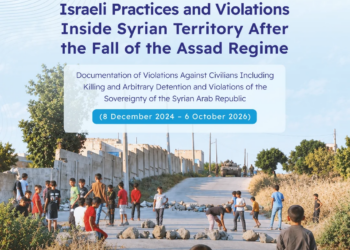
Israeli Practices and Violations Inside Syrian Territory After the Fall of the Assad Regime
Quotes to the Media

Israeli Practices and Violations Inside Syrian Territory After the Fall of the Assad Regime

5 October 2026
After 90,000 cases, how can Syria restore rights lost to the Anti-Terrorism Court?
Quotes to the Media

After 90,000 cases, how can Syria restore rights lost to the Anti-Terrorism Court?

20 September 2026
Syria’s abolition of Assad-era terrorism court ‘welcome’
Quotes to the Media

Syria’s abolition of Assad-era terrorism court ‘welcome’

18 September 2026
SNHR director: Athar paves way for unified national missing persons registry
Quotes to the Media

Syrian Network for Human Rights welcomes abolition of Terrorism Court

17 September 2026
Tweets by Fadel
Fadel Abdul Ghany

Fadel Abdulghany

Founder and Head of the Syrian Network for Human Rights from June 2011 to date.

Master’s in International Law (LLM)/ De Montfort University/ Leicester, UK (March 2020).

Bachelorette in Civil Engineering /Projects Management / Damascus University.

Recent Posts

  • Ali Kayali, Main Suspect in 2013 Baniyas Massacre, Arrested
  • Expropriation in Syria: Will Reconstruction Turn into a Continuation of the Injustices of the Past?
  • When Does Military Purpose Justification Become Acceptable? Competing Reasoning and Genocidal Intent in South Africa v. Israel

Quick links

  • Home
  • BIO
  • Articles
  • Researches
  • Books
  • Quotes to the Media
  • Transitional Justice
  • Interviews
    • Talks and Lectures
    • Videos

© 2023 SNHR - Fadel Abdul Ghany.

No Result
View All Result
  • Home
  • BIO
  • Articles
  • Researches
  • Books
  • Quotes to the Media
  • Transitional Justice
  • Interviews
    • Talks and Lectures
    • Videos

© 2023 SNHR - Fadel Abdul Ghany.