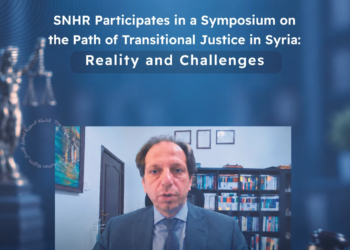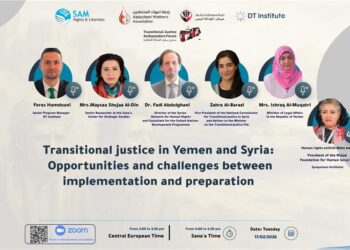
In the context of discussing demands by some residents of Suwayda for independence or autonomy, Syrian rights advocate Fadel Abdulghany explained that “self-determination” is one of the most complex and controversial principles of international law, because it intersects with the principles of state sovereignty and territorial integrity, two basic pillars of the international order.
Abdulghany noted that this contradiction places the international community before a difficult equation between recognizing peoples’ right to choose their political future and, at the same time, preserving border stability and preventing the breakup of states.
The rights advocate said the idea of self-determination historically moved from a political proposal advanced by Woodrow Wilson to a legal principle in the United Nations Charter. But it remained governed by a delicate balance between peoples’ aspirations for independence and the requirements of international stability, making it subject to an equation in which politics and law overlap. It is theoretically recognized as a fundamental right, but in practice restricted by the priority of territorial integrity when it conflicts with separatist demands.
He also noted that Article 1 (2) of the UN Charter, which provided for peoples’ right to self-determination, came in an inconclusive formulation that reflected the balance of power between colonial states and emerging states at the time.
With the 1966 international covenants, the International Covenant on Civil and Political Rights and the International Covenant on Economic, Social and Cultural Rights, self-determination became a clearer universal right, granting peoples the right to determine their political status and development. Yet its practical application remained subject to complex political and legal considerations.
Article 1 (2) of the United Nations Charter:
Equal rights and the right of peoples to self-determination. Article 1 (2) states that among the basic purposes of the United Nations, and therefore of the Security Council, is to develop friendly international relations based on respect for the principle of equal rights and the right of peoples to determine their own destiny.
Ideas Between Autonomy and Separation
Rights advocate Abdulghany noted that the right to self-determination has multiple forms, but under strict limitations.
In some circles inside Suwayda, ideas are being raised that range between “autonomy” and “full separation,” which also leads to distinguishing between two types of self-determination, internal and external.
International law has developed several forms of self-determination, most notably:
- External self-determination, leading to independence, which is the most sensitive and the most restricted.
- Internal self-determination, achieved through autonomy and democracy within the state, which is the most internationally accepted form.
The Syrian rights advocate stressed that in the case of Suwayda governorate, all forms of self-determination face strict ceilings imposed by state sovereignty and territorial integrity.
Article 2 (4) of the United Nations Charter prohibits the use of force against the unity of states, creating a legal obstacle before separatist movements.
The 1970 Friendly Relations Declaration reinforced this direction, as Abdulghany stressed that self-determination may not be used to dismantle states except in exceptional cases, such as colonialism, occupation, or racist regimes.
Decisions Governed by Politics, Not Law
International experiences show that demands for self-determination are not all treated in the same way. This applies to the case of Suwayda, as the international community does not rely only on law, but is also significantly influenced by politics and interests.
Rights advocate Abdulghany said, “There are no clear or unified standards for evaluating self-determination demands, which makes its application selective and subject to political calculations. While internal self-determination enjoys broad acceptance, external self-determination faces strict restrictions.”
In colonial cases, the right to independence was almost absolute, as in the 1960 Declaration, but outside this context the matter becomes more complex.
What Is the 1960 Declaration?
It is a historic resolution adopted by the United Nations General Assembly, also known as Resolution 1514, and is considered one of the most important documents that established the principle of decolonization in international law.
The declaration stated that all peoples have the right to self-determination, and that colonialism constitutes a denial of this right and a violation of fundamental human rights. It also called for transferring power to colonized peoples without conditions or delay, ensuring their freedom and full independence.
International Respect for Constitutions That Ban Separation
Rights advocate Abdulghany said the Syrian constitution, like many constitutions, does not permit separation, which strengthens the international position rejecting Suwayda’s separation from Syria. This difficulty increases with the absence of a clear definition of the concept of “the people,” opening the door to questioning any demand for independence.
Economic and security concerns also play a role in rejecting the demands of some Suwayda residents, out of fear that the separatist contagion could spread to other areas.
Abdulghany added that international rejection of self-determination demands is often the result of the overlap between law and politics. The principle of territorial integrity creates a strong presumption against recognizing separation, limiting this right to rare cases.
Geopolitical calculations greatly influence recognition decisions, as the interests of major powers determine the outcomes of cases more than legal rules do. Many national constitutions also ban separation, which is respected under international law, according to Abdulghany.