Fadel Abdulghany
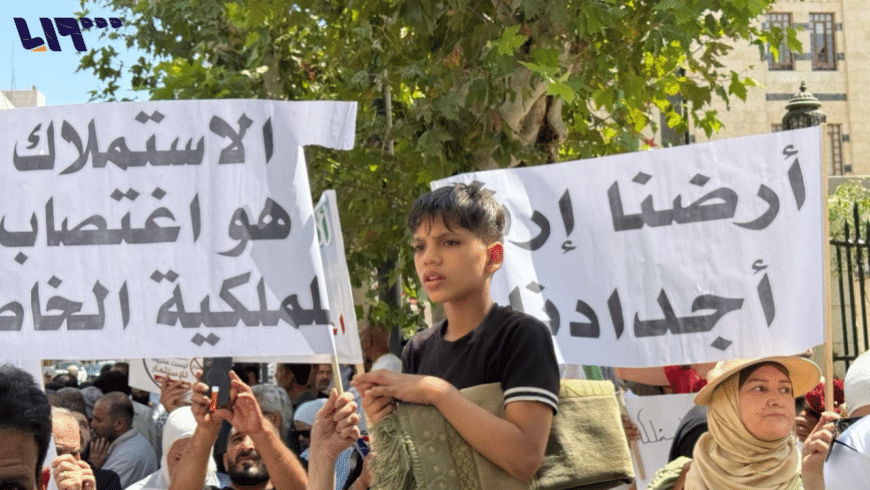
In September 2026, dozens of residents of the suburbs of Dummar and Qudsaya, and of Moadamiyet al-Sham, headed to the offices of the “Sham View” and “Abyat Hills” projects in Qudsaya Suburb, in Rural Damascus, demanding a halt to construction on lands that had been expropriated under the former regime.
Two days later, the Ministry of Public Works and Housing responded with a statement in which it affirmed that expropriation is a legal instrument adopted by states, that the lands had been transferred to public entities decades ago and their expropriation compensation had been deposited, and that the delay in implementing the projects does not lead to the restoration of ownership as long as the public benefit remains in place. On the same day, an office was opened in the municipality of Qudsaya Suburb to receive complaints.
Most of what the Ministry’s statement contained is correct as general rules; however, it does not answer the core of the dispute. The legitimacy of expropriation as a legal instrument is not the subject of serious dispute; rather, the dispute revolves around four issues that the land registry entry alone does not settle: the soundness of the original expropriation decision; the fairness of the compensation and whether it reached its rightful recipient; the fate of the purpose for which the land was expropriated; and the legality of disposing of it today.
The Ministry itself affirmed that rights relating to a specific property are settled by reference to the records and to the proofs of deposit, receipt, and transfer of ownership; however, these documents are held by the administration, and none of those relating to either of the two projects have been published. Whoever holds these records bears the responsibility of disclosing them.
The problem begins with the legislative text itself. Legislative Decree No. 20 of 1983 includes among the purposes of public benefit tourist facilities, the projects of development and investment plans, and the projects falling within the competence of public entities, in addition to the facilities of the Ba’ath Party. Article 4 also permits the entities supervising housing to expropriate properties and divide them into plots for the purpose of constructing popular housing, provided that these plots are sold at cost price.
Therefore, it is difficult to assert, before the expropriation decrees of the lands of the two projects are published, that their expropriation went beyond the purposes permitted by law; the problem lies in the breadth of these purposes, not in a departure from them. This breadth grants the administration a wide discretionary power, and it weakens the safeguards relating to proving the actual need to expropriate a particular property and its area. Then comes Article 7, which renders the expropriation decree final and not subject to any form of appeal or review.
While the Ministry’s statement spoke of guaranteeing the right of those affected to object and to seek review, the law regulates objections to the assessment of compensation and disputes relating to ownership, and it renders the decision of the committee for the reconsideration of the assessment final as well. As for the expropriation decision itself, the text immunizes it from appeal.
The Constitutional Declaration issued on March 13, 2025, sets a different standard. Article 16 thereof does not permit the expropriation of private property except for the public benefit and in return for fair compensation, Article 17 prohibits immunizing any administrative act or decision from judicial oversight, while Article 12 makes the rights contained in the ratified human rights treaties an integral part of it.
On the other hand, Article 51 keeps the laws in force effective until they are amended or repealed, and Article 48, which relates to exceptional laws, does not specifically mention the Expropriation Law. Thus, the 1983 law remains operative; however, its continued operation does not shield its Article 7 from a serious constitutional challenge, particularly if the judiciary characterizes a decree expropriating specific properties as an administrative act by virtue of its content.
Resolving this challenge judicially or legislatively does not automatically lead to the annulment of the old decrees; rather, it opens the way for examining them. Indeed, the law itself presupposes, in Article 26, the possibility of a judicial ruling annulling a previous expropriation, as it regulates the issuance of a new expropriation decree to remedy a formal defect resulting from such a ruling. Hence, review is not impossible, even if its scope, its time limits, and the determination of the court competent to hear it today remain issues that need to be settled.
As for the delay in implementing the projects, the rule on which the Ministry relies is sound: the law does not contain a general provision mandating the return of land to its owner merely due to the passage of time, and Article 35 addresses a specific case relating to properties that were actually allocated to the public benefit and then lost this status. However, the continuation of the public benefit is a condition that requires proof, and the law does not grant the administration an open mandate to change the use of expropriated lands; its reference to changing the planning designation to another public-benefit purpose appears in a specific context relating to the reassessment of compensation, while the change itself remains subject to its own legal basis and procedures.
Therefore, verification begins with two documents that have not been published: the purpose specified in the original expropriation decree, and the decision on which the conversion of the land to its current purpose was based. The benefit that the new project is supposed to bring to society, which itself requires proof, does not remedy a possible defect in the origin of the expropriation, nor does it alone establish the legality of directing the land to it.
The participation of a private investor does not negate the existence of a public benefit. Legislative Decree No. 26 of 2015 permits the General Housing Establishment to implement its projects through public-private partnership and to conclude investment contracts, and it obliges it to allocate no less than 70% of the dwellings and residential plots included in its five-year plans to social housing, a percentage that is calculated at the level of the plan and not at the level of each project.
The Ministry affirms that the public entity retains its rights and revenues under the partnership model, and that these revenues contribute to supporting affordable housing. This may be true; however, verifying it remains impossible as long as the partnership contracts with the Saudi companies “Abyat” and “Thara” remain unpublished, as do the valuation of the land and the share of social housing. Moreover, the announced estimated price per square meter in “Sham View,” which ranges between 1,180 and 1,460 US dollars, does not prove the existence of a violation, but it does raise a question about the ability of the targeted groups to purchase.
In this context, General Comment No. 26 (2022) on land and economic, social and cultural rights, issued by the Committee on Economic, Social and Cultural Rights in its interpretation of the obligations under the International Covenant on Economic, Social and Cultural Rights, stresses the necessity of defining the public purpose in a manner that allows it to be subjected to judicial oversight, and it considers the invocation of the public benefit to justify the expropriation of lands, and their sale or lease to investors, to be among the areas where corruption is rampant in land administration.
On the issue of compensation, a distinction should be made between four matters: the assessment of the compensation, its deposit, its receipt, and the extent of its fairness. The Expropriation Law permits the expropriating entity to deposit the compensation amount in trust for the benefit of its owner, without accruing interest, and it permits, in the cases specified by law, the registration of the property in the name of the expropriating entity after the deposit of the compensation, even if its owner has not actually received the amount. It also allows, in certain cases, the publication of a notice in a newspaper instead of personal notification.
More problematic is that the law provides for the lapse of the entitled person’s right to receive the deposited amount if fifteen years have passed since its deposit without the prescription period being interrupted in accordance with the law, whereupon the amount is returned to the treasury of the expropriating entity. This lapse relates specifically to the right to receive the deposited amount, and it does not necessarily mean the lapse of all other rights or legal claims relating to the expropriation or to the compensation for it.
Thus, the procedures may be completed in the records without the compensation reaching the entitled person, such as when the entitled person is absent, or is deceased and his heirs have been unable to establish their status as heirs. And when the compensation is paid after years of delay, the law addresses this with limited interest and prohibits reassessment.
Therefore, what the Ministry states regarding deposit and disbursement is not sufficient on its own to prove that the compensation obligation has been fulfilled in each individual case. The Ministry is correct that the price of the land after decades of planning and public spending is not, on its own, a suitable measure of its value at the time of expropriation. A fair valuation starts from the value of the land at the time it was expropriated, taking into account inflation, the period of deprivation of use, and the date of actual receipt.
Rights holders do not constitute a single group; among them are heirs, opponents of the Assad regime, displaced persons, women who face difficulties in proving their legal status or in appearing within the specified deadlines, agricultural tenants whose contracts may entitle them to an independent share of the expropriation compensation, and former owners who may be entitled, under conditions that differ depending on the applicable legal regime, to priority in obtaining a dwelling or to a housing allocation. The Ministry has stated that some of these have benefited from allocations and purchase priorities, which calls for a clear statement of who has benefited and who has not, without a general presumption in either direction.
It was not the current government that issued the old expropriation decrees; however, it is responsible for the current contracting and marketing decisions, and therefore timing acquires a pivotal importance in this file. The subscription for the first two thousand units in “Sham View” began on September 22, with allocation to begin within four months of signing the application form, while delivery is expected in 2029.
According to the General Housing Establishment, paying the subscription amount does not grant ownership or a final allocation, but it does create contractual obligations that have already begun to arise. With each subsequent stage, new parties enter, and any potential settlement becomes more complex and costly. Moreover, no decision has been published that regulates the work of the complaints office and defines its powers, its time limits, the possibility of objecting to its findings, and the effect of its review on litigation deadlines.
Addressing this issue does not require halting reconstruction; rather, it requires, first, the publication of the expropriation decrees and their purposes, the schedules of deposit and receipt, and the partnership contracts. It also requires a legislative amendment that lifts the immunity from the expropriation decision and the assessment of compensation, and that establishes a clear legal basis for the matters that the current law does not adequately address, particularly the cases in which land that is no longer needed for a public purpose may be returned, and the cases in which restitution is replaced by supplementary compensation, while protecting the rights acquired by third parties.
It also calls for the establishment of an independent body to review claims, whose decisions are subject to judicial oversight, and which begins by processing the established entitlements and ensuring their payment, and by examining serious claims before the allocation procedures are completed. When a serious claim relates to a specific plot, suspending its disposal by a temporary and reasoned decision may be less harmful than the emergence of a later dispute with buyers.
The transfer of land to the state under an old expropriation decree creates a legal situation whose effects should be respected until it is reviewed through legitimate means. However, it does not exempt the current authorities from two responsibilities: verifying the legality of the new disposal of the land, and addressing the rights and grievances that have remained unsettled.
Syria can proceed with reconstruction on previously expropriated lands, provided that the examination of rights precedes the final disposal of the land. However, if this order is reversed, landowners and subscribers alike may be harmed, and reconstruction would turn into an extension of past injustices, even if the old expropriation decrees were formally valid.
The opportunity has not yet been missed. If the documents are published, the immunity is lifted from expropriation decisions, and an independent body is established to consider claims before allocation is completed, then no heir will have to search the corridors of the administration for a deposit receipt that his father never saw, and no subscriber who saved for years for the price of his apartment will fear that one day someone will knock on his door saying that it was built on his land. At that point, the new buildings on the outskirts of Qudsaya and Dummar will not be a marker of a deferred dispute, but rather a witness that the new Syria is capable of rebuilding the land and doing justice to its people at the same time; for the reconstruction that begins with doing justice to the owners of the land is the only one that endures.