Fadel Abdulghany
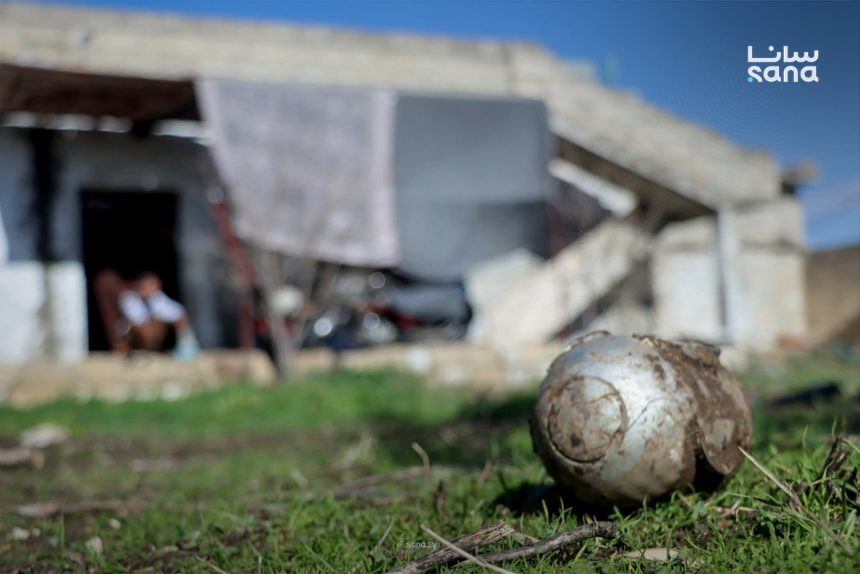
No new known use of cluster munitions has been recorded in Syria since the fall of the Assad regime in late 2024. However, in 2025, the country recorded the highest number in the world of people killed and injured by the remnants of these munitions. This is what the report “Cluster Munition Monitor 2026” sets out: 68 people killed or injured in Syria, out of 117 people recorded worldwide as casualties of cluster munition remnants.
However, to read the first part of this finding as a closure of the file would be an inaccurate reading. It is from here, in my assessment, that the urgent task of the Syrian government and the donor states begins.
The Monitor recorded at least 1,063 people killed or injured by cluster munitions worldwide during 2025, of whom 946 were casualties of attacks and 117 were casualties of remnants. The share of Syria, which is approximately 58 percent, is calculated from the second figure, not from the total. Moreover, the Monitor does not list Syria among the countries where use during 2025 and 2026 is believed or suspected to have resulted in new contamination. Thus, the 68 casualties were caused by the remnants of past use. Hence, the problem has shifted from the attack itself to what the attack has left behind.
This past use is documented. Indeed, the Syrian Network for Human Rights (SNHR), which has been the member of the Monitor for Syria since 2020, has documented the use of cluster munitions in the country since 2012. The entry of Syria in the timeline of use of the Monitor stands at the period from 2012 to 2024. As for the cumulative toll in its database up to the end of 2025, it amounts to 4,557 recorded casualties (killed and injured) resulting from attacks and remnants combined, a total exceeded only by that of Laos.
The responsibility for past use is a matter connected to the actors to whom that conduct is attributable, and the use attributed to the former regime cannot properly be attributed to the current government merely because it governs the state today. As for the current government, it is the one capable of taking the decisions on survey, marking, clearance, risk education, and the expansion of victim assistance. What it has inherited is the contamination left behind by past use, and upon it today falls the task of dealing with the consequences of that contamination.
This work does not begin from a vacuum. Within the Ministry of Emergency and Disaster Management, there is the National Mine Action Center, which is in charge of oversight and coordination with the relevant actors. The Ministry has reported that its teams for the clearance of explosive remnants of war and for mine action carried out, in the first half of 2026, approximately 981 operations for the clearance of unexploded ordnance, 369 non-technical survey operations, and 631 risk education sessions.
The Center is also preparing a three-year national strategy, one of whose pillars is the establishment of a unified national information management system for the collection of data on contamination. Mine clearance operations have had a human cost as well: SNHR documented that, from the fall of Assad until April 4, 2026, 47 people were killed during demining operations, among them 40 members of the engineering units of the Syrian Ministry of Defense. These are actual efforts that count to the credit of the government and its field teams; however, the scale and extent of the contamination require the continued expansion of national capacities and of international support.
The starting point for building a national policy on this file is, as I see it, the completion of a comprehensive national survey. As of July 2026, Syria was among 29 countries and other areas known to be contaminated by cluster munition remnants, and the estimates dated December 31, 2025, place this contamination in the medium category, that is, between 10 and 99 square kilometers. However, the Monitor stresses that this classification is an estimate, and that the contamination in Syria has been identified only to a limited extent and has not been subject to a comprehensive survey.
Therefore, the government, in coordination with the United Nations and the competent national and international bodies, must complete this survey and expedite it, identify the suspected hazardous areas, place clear markings and warnings in them, and expand risk education and clearance operations according to priorities that are based on the level of danger and the needs of local communities. I do not mean by this that these measures should wait for the completion of the survey; rather, they should proceed in parallel with it.
The Monitor also lists Syria, alongside Myanmar and Ukraine, among the states not party where victim assistance services were among the most affected. The Monitor reported shortages in emergency medical care, rehabilitation, prosthetic and orthotic devices, psychosocial support, and economic inclusion, particularly outside the main cities. On top of that, survivors in rural areas face long distances and the high cost of reaching services.
Some of these shortcomings are attributable to a lack of resources and investment, and here comes the role of the donor states and the United Nations in increasing their financial, logistical, and technical support for survey, clearance, risk education, and victim assistance.
There remains the position of Syria on the 2008 Convention on Cluster Munitions. Syria has not signed it and is not a party to it, though it has attended some of its meetings as an observer. It is one of 11 states not party confirmed to have used these munitions since the entry into force of the Convention in August 2010.
I call on the Syrian government to take formal steps toward accession, and, independently of accession, to declare a permanent national commitment not to use, produce, stockpile, or transfer cluster munitions. It may be objected that the government has more pressing priorities. However, this declaration is a political decision that does not wait upon the completion of accession procedures, nor does it in itself require the financial and operational resources that survey and clearance work requires. It is, furthermore, distinct from the status of a State Party to the Convention.
The absence of recorded new use is important; however, we are in need of further efforts, and at various levels. So long as the contaminated land remains unidentified, civilians remain exposed to danger, survivors lack adequate assistance, and Syria has not yet formalized a permanent national commitment against future use, the harm of past use continues, and we hope that it will cease soon.