Fadel Abdulghany
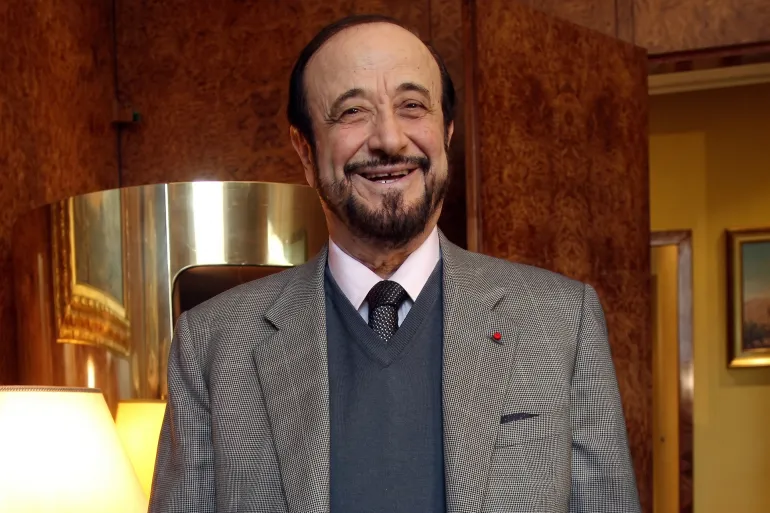
On November 7, 2026, the Syrian Arab News Agency (SANA) reported that the Director of International Cooperation at the Ministry of Foreign Affairs and Expatriates, Qutaiba Qadish, who was appointed on the same day as Assistant Minister of Foreign Affairs and Expatriates for International Cooperation Affairs, agreed in Paris with the French Special Envoy for Syria, Jean-François Guillaume, on the formation of a joint governance committee to oversee the development projects that will be funded by the money confiscated from Rifaat al-Assad, as well as on the exchange of project proposals over the following week.
The agency stated that the two sides discussed the completion of the procedures required to accelerate the deployment of approximately 54 million euros of the funds confiscated from Rifaat al-Assad into development projects in Syria, and that they agreed to form a joint governance committee to oversee these projects and to exchange project proposals.
The meeting comes as a follow-up to the declaration of intent signed by the Syrian Foreign Minister Asaad al-Shaibani and the French Foreign Minister Jean-Noël Barrot in Damascus on July 7, 2026, during the visit of the President Emmanuel Macron, in order to launch the procedures for returning funds confiscated from Rifaat al-Assad and employing them for the benefit of Syrians.
On July 16, the spokesperson of the French Ministry of Foreign Affairs clarified that the programs to be funded had not yet been determined. Understanding what has taken place therefore requires distinguishing between its stages: first, the confiscation of assets valued at approximately 90 million euros (about 99 million dollars), which became final with the ruling of the French Court of Cassation in September 2022; then, an allocation in a declaration of intent; then, an agreement on a governance mechanism. As for the transfer and the spending, they are the two stages yet to come.
The French law issued in August 2021 directs the proceeds of this type of confiscation to cooperation and development projects for the benefit of the populations concerned, and it requires respect for the principles of transparency and accountability as well as care to involve civil society organizations, while preserving the right of the civil parties to compensation.
The circular of the Office of the French Prime Minister, issued in November 2022 to regulate the mechanism, prohibits any transfer of the funds before their concrete allocations have been clearly and definitively determined. This means that the door to allocation is still open, and that reparation programs can be designed within this development framework.
Hence, the most important question has become a specific one: who will sit on the governance committee, and will the victims of the former regime and their families have a role in setting the priorities before the proposals are adopted?
It is a question that does not weigh reconstruction against the victims; rather, it concerns the very meaning of reconstruction in a country where the plunder of resources has been intertwined with repression.
The Syrian Network for Human Rights (SNHR), as part of the “Asset Recovery for Justice in Syria” working group, participated in the preparation of a research paper that proposes allocating a portion of corruption-linked assets to reparations for victims wherever corruption has enabled, sustained, or benefited from gross violations, alongside the general needs of reconstruction and not as a substitute for them.
This proposal is built on the fact that corruption under the two Assads was not limited to bribery and the privileges of those close to power. Detention and enforced disappearance were turned into a source of income: the confiscation of the money of detainees, and sums paid by families in exchange for information on the fate of their loved ones, for an improvement in the conditions of their detention, or for their release.
SNHR has documented large-scale looting and confiscation of land and property across the areas over which the forces of Assad regained control, where the contents of homes were looted and then sold through tenders for the “looting of buildings.”
The loss did not stop at the value of the furniture or the property; a lost home means the loss of stability, a confiscated workshop means the interruption of income, and the extortion of the family of a detainee may drain its savings.
The case of Rifaat al-Assad himself is reflective of this interconnection, as he was convicted in France of laundering embezzled Syrian public funds as part of an organized gang, in addition to aggravated tax fraud. As for the violations, they were the subject of separate proceedings.
On March 11, 2024, the Office of the Attorney General of Switzerland indicted him before the Federal Criminal Court for war crimes and crimes against humanity over the events of Hama in February 1982, when he was the commander of the Defense Companies (Saraya al-Difa); the court then closed the case on March 31, 2026, following his death on January 20 of the same year.
The two cases are legally separate, yet they reveal the convergence of political power, illicit enrichment, and violence in the very same individuals and institutions. It is on this structural basis that the proposal to allocate part of the funds to reparations rests, and not on the necessity of proving a direct link between every euro and a specific violation.
From a legal standpoint, Syria is a State Party to the International Covenant on Civil and Political Rights, which obliges States Parties, under paragraph 3 of its Article 2, to ensure an effective remedy for any person whose rights have been violated.
The “Basic Principles and Guidelines on the Right to a Remedy and Reparation for Victims of Gross Violations of International Human Rights Law and Serious Violations of International Humanitarian Law,” adopted by the United Nations General Assembly in 2005 (Resolution 60/147), set out the forms of reparation: restitution, compensation, rehabilitation, satisfaction, and guarantees of non-repetition. These principles are an elaboration of obligations that already exist.
Reparation differs from humanitarian assistance; assistance responds to need, whereas reparation acknowledges the right of the victim and the responsibility for the harm inflicted upon them.
As for the return of assets, it is governed by judicial rulings, national laws, and bilateral agreements that leave states a margin of discretion in allocation, and it is this margin that allows part of the funds to be directed to reparations, while distinguishing between the restitution of property to those owners whose rights are established, compensation for violations, the developmental allocation of the proceeds, and respect for the rights of bona fide third parties.
Syria signed the United Nations Convention against Corruption in 2003, and the government is currently working to complete its ratification, a step that will allow it to invoke Article 57 on the return and disposal of assets as a State Party.
The 2017 “GFAR Principles for Disposition and Transfer of Confiscated Stolen Assets in Corruption Cases” of the Global Forum on Asset Recovery call for assets, where possible, to benefit the people of the affected country without prejudice to identified victims, while the “Recommended Principles on Human Rights and Asset Recovery” issued by the Office of the United Nations High Commissioner for Human Rights (OHCHR) in 2022 link effective remedy to participatory allocation. These principles, despite their non-binding nature, thus provide a clear basis for a negotiation in which states exercise their discretionary power in favor of the victims.
The new governance committee in Syria has before it an opportunity to give victims a clear position within it, one that begins before the adoption of the final agreement, through participation in the distribution of resources and in the setting of selection criteria.
Since the needs of torture survivors differ from those of survivors of sexual violence, of the families of the missing, of the displaced, and of those whose property was seized, their representation requires more than a single voice. This requires a safe and confidential participation, as well as a public explanation of the impact of the proposals of victims on the decision.
It also requires the publication of the amounts and their legal basis, the agreements, the implementing entities, and the results of independent audits. The direct impact can be measured, such as a survivor obtaining treatment or compensation or regaining a livelihood. As for the broader impact, such as an increased capacity to work and a strengthened trust in institutions, it is achieved through the sound design of the programs.
Reparation is complementary to the repair of water and electricity networks and hospitals, not a competitor to it, and it requires urgent interim measures, since delay multiplies the harm.
These funds will finance only a limited portion of the needs of victims and of reconstruction, and other assets linked to the family of Rifaat al-Assad remain seized in Spain pending a money laundering case that has not yet been decided.
However, the French track is the first publicly announced track for returning assets confiscated from the Assad family, and whatever is agreed upon regarding it will become a reference for what follows. Damascus and Paris therefore have an opportunity today to make it a model to be emulated, through a governance committee on which survivors sit, publicly announced allocation criteria, and a portion of the funds going to reparations alongside the development projects.
If the work is done well, these funds may mean treatment for a survivor who left detention with a worn-out body, a workshop returned to its owner, and a school seat for the son of a detainee whose family drained its savings in the search for his father. Only then will the plundered funds have truly returned to their owners: the citizens who paid the price of their plunder.