Kars de Bruijne, Fadel Abdul Ghany
The Armed Conflict Location & Event Data Project (ACLED) and the Syrian Network for Human Rights (SNHR) collaborate – together with a large group of information providers – to collect and triangulate information on Syria. Other providers of information are the Syrian Observatory for Human Rights (SOHR), Airwars, the Carter Center, the International Security and Development Centre (ISDC), the Clingendael Institute, LiveUaMap, Shaam News, Syria Direct, the London School of Economics Conflict Research Group, and a number of undisclosed sources.
The data collected by this consortium will inform a better understanding of the nature of the conflict. Humanitarian organizations may use these realtime data for needs assessments of areas hit by mining and cluster munitions or to account for IDP-movement. Journalists may use these data to understand the hundreds of militias operating in Syria currently and the different types of violence they display. Governments and advocacy organizations may use these data to assess culpability and keep track of violations. However, these data may be most crucial in the future when Syria is rebuilt. These data will document the areas in which there have been the most violence and those in which civilians have suffered the most harm.
The creation of this consortium was motivated by the realization that to truly understand the realities of the Syrian conflict, genuine collaboration is required. No organization has a network of information in each and every Syrian village, but each has its own areas of geographic expertise. No organization can keep track of all flight movements above Syria, but some may possess the ability to identify where the Global Coalition and the Russian state are dropping their bombs. No organization keeps track of every troop movement in the country, but some may effectively track territorial gains made by the regime. It is this realization, that only genuine collaboration allows for a comprehensive understanding of the day-to-day realities of the Syrian conflict, which spurred SNHR to share its data with ACLED. This article reflects on the contribution of SNHR data to ACLED.
SNHR’s contribution
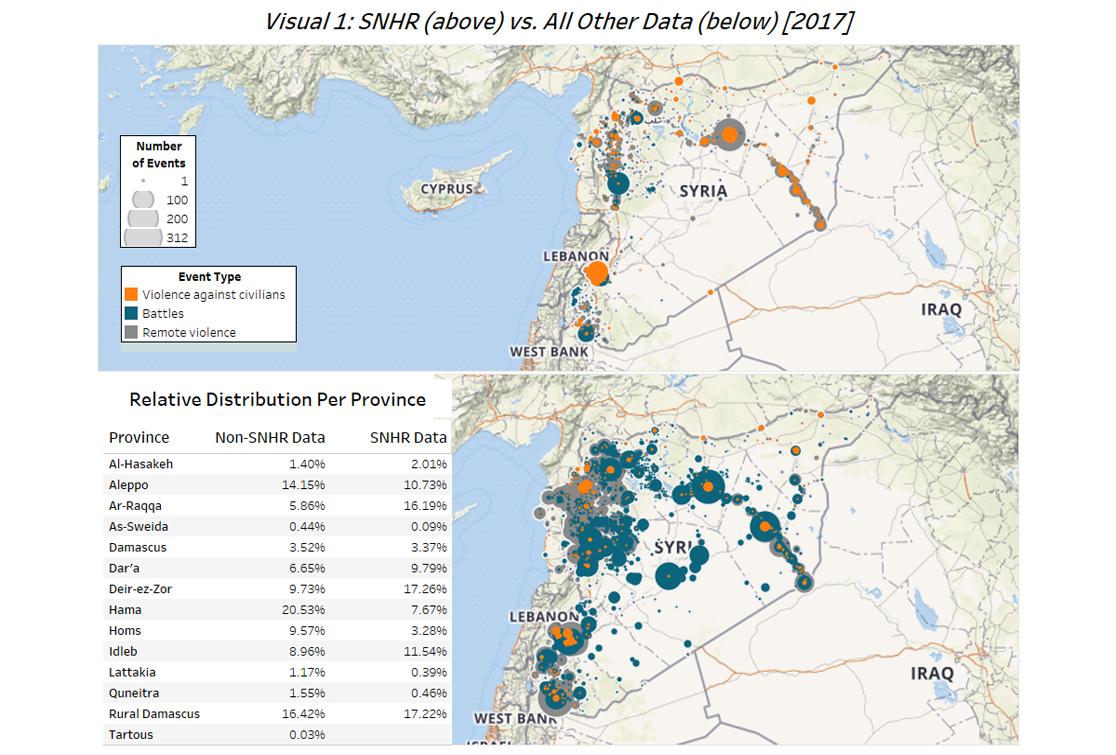
The unique features of the data provided by SNHR are as follows: 1) unrivaled coverage of violence perpetrated in Deir-ez-Zor, Raqqa, and Al-Hasakeh; 2) the unique ability to shed light on the deliberate targeting of civilians as a means of war; and 3) the inclusion of carefully collected and verified information on perpetrators. Overall, SNHR provides 15% of events within the ACLED Syrian dataset (about 5,000 out of 30,000 events as of July 2018).
Figure 1 below compares the coverage of incidents of political violence by SNHR to the violence reported by other organizations in the network. The figure displays the three most common types of violence in the data: 1) incidents of shelling, IED usage, and airstrikes (i.e. remote violence); 2) battles; and 3) unilateral/deliberate violence against civilians (e.g. targeted killing, murder, mine campaigns). Comparing the map at the top and bottom of the figure, SNHR data cover violence along the Euphrates (both in Raqqa and Deir-Ez-Zor), Idleb, and Dara particularly well. The table in the same figure corroborates this finding, highlighting that the share of events reported in these districts is relatively higher than those reported by all other information providers.