Fadel Abdulghany
This article argues that the trial of Atef Najib, Bashar al-Assad’s maternal cousin and the former head of the Political Security Branch in Daraa, which opened before the Fourth Criminal Court in Damascus on 26 April 2026, represents the most significant criminal proceeding in post-Assad Syria. At the same time, it reveals three fundamental problems. The first concerns the legal framework: charges of murder, torture, and systematic abuses are being prosecuted under Syria’s ordinary 1949 Penal Code, a statute structurally incapable of recognizing the institutional and policy character of these crimes in the manner required by international criminal law. The second concerns the in-absentia charges brought against Bashar al-Assad and Maher al-Assad; despite their limited present enforceability, they perform a pivotal legal function by anchoring judicial accountability and paving the way for international cooperation. The third is an explicit warning against executing Najib before the full record of the chain of command and the fate of the forcibly disappeared has been documented, given the irreparable evidentiary loss this would entail. The article concludes that the 10 May 2026 hearing will be the first real test of the integrity of these proceedings, and that the rigor of the legal standards applied will determine whether this trial becomes a cornerstone of the accountability architecture Syria needs.
On 26 April 2026, the Fourth Criminal Court at the Palace of Justice in Damascus held a preliminary hearing in what is regarded as the most significant criminal proceeding Syria has witnessed since the fall of the Assad regime.
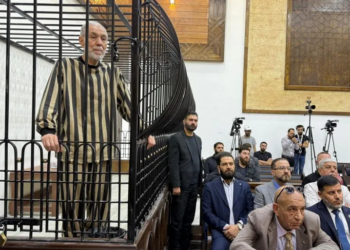
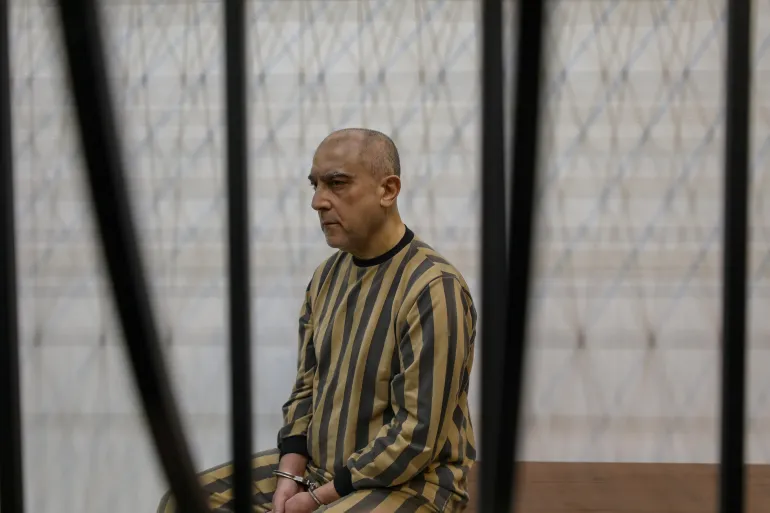
Atef Najib, a brigadier general and the maternal cousin of Bashar al-Assad, appeared in the dock with his hands shackled. The Public Prosecutor of the Republic attended the hearing, alongside families of victims, predominantly from Daraa governorate.
There was no questioning, no testimony was heard, and no plea of guilty or not guilty was entered; the session was adjourned to 10 May 2026, when the substantive proceedings are expected to begin. Procedurally, what took place was unremarkable, yet its significance for Syria’s accountability architecture is of an entirely different order.
Najib served as head of the Political Security Branch in Daraa governorate, and was arrested in Latakia in January 2025.
He is accused, in his capacity as a member of the Daraa Security Committee, of overseeing arrest and interrogation operations and of issuing orders for the brutal suppression of the March 2011 demonstrations, which resulted in civilian casualties and the arrest, torture, and disappearance of thousands of Syrians.
The symbolism these charges carry is unmistakable: Daraa is the cradle of the Syrian uprising, and Najib is the single most direct link between the regime’s security apparatus and that founding moment.
The formal charges, as reported, include crimes against the Syrian people, encompassing murder, torture, and the supervision of widespread abuses against civilians. Additional charges against other defendants include extortion and drug trafficking.
Yet the legal framework under which these charges proceed imposes a structural constraint that bears directly on what the trial can achieve. Syrian Penal Code No. 148 of 1949 contains no provisions that explicitly criminalize war crimes or crimes against humanity as autonomous legal categories.
Instead, conduct that may satisfy the definitional elements of Article 7 of the Rome Statute, namely, the commission of a widespread or systematic attack directed against a civilian population, that is, crimes against humanity, will be prosecuted under the provisions of the ordinary criminal code, such as murder and torture. The consequence is more than a matter of terminology.
A conviction under these provisions, however severe the sentence, will not constitute a judicial recognition of the systematic and institutional character of the crimes; it will record individual criminal acts, but it will not record the policy that produced them.
Put differently, the trial is operating within a legal vocabulary that is structurally unable to capture the nature of the crimes it seeks to address.
This shortfall is compounded by the gap between the current judicial framework and the transitional justice architecture being built. The National Commission for Transitional Justice was established by Decree No. 20 of May 2025, and its membership was constituted by Decree No. 149 of August 2025.
A draft transitional justice law is being prepared but has not yet been enacted. The Commission is a body concerned with truth, accountability, and reparations; it has no power to conduct criminal trials.
The draft law that is intended to establish specialized criminal chambers capable of applying international criminal law categories has not yet been passed. Until that happens, criminal proceedings will continue to be brought under the ordinary Penal Code.
In the same court, in absentia charges have been brought against Bashar al-Assad, Maher al-Assad, and other senior former officials. A judicial arrest warrant was issued against Bashar al-Assad on 25 April 2026. Maher al-Assad, who commanded the Fourth Armored Division, faces charges of murder, torture, extortion, and drug trafficking.
The current enforceability of these charges is minimal; Bashar al-Assad is in Russia, which has no extradition treaty with Syria and has historically shielded officials of the Assad era from accountability.
Nor do in absentia proceedings provide any immediate enforcement mechanism. Their importance, however, lies elsewhere: they foreclose future claims of impunity and establish a domestic judicial determination of criminal responsibility.
In addition, building a coherent case file grounded in criminal evidence rather than political motivation is a precondition for any cooperation request to Interpol; Article 3 of the organization’s Constitution prohibits intervention in matters of a political character.
The rigor of the domestic case file, and its grounding in documented criminal facts, are therefore what separate the possibility of an international Red Notice against al-Assad from a collision with the organization’s restrictions on involvement in politically motivated prosecutions.
In this sense, the in-absentia charges are tools for building the legal architecture of accountability, not tools for immediate detention.
The question of the death penalty adds a further layer of difficulty. Syria still retains capital punishment, and the families of victims have publicly expressed their hope that Najib will receive the maximum penalty. Two distinct objections arise here.
The first rests on international human rights law: Syria is a State Party to the International Covenant on Civil and Political Rights, Article 6(2) of which restricts the death penalty to «the most serious crimes», a category the Human Rights Committee interprets as confined to intentional killing.
Syrian national law, by contrast, applies the death penalty more broadly, placing it outside the scope of compliance with the Covenant. The imposition and execution of a death sentence in this trial would expose the current government to international criticism at a time when it is seeking legitimacy and renewed engagement with international institutions.
Whatever the future of the death penalty in Syrian legislation, the minimum standard the transitional government should observe is a prohibition on carrying out executions in public squares; this practice contravenes the prohibition of cruel, inhuman, or degrading treatment under Article 7 of the Covenant, and transforms the punishment from a judicial measure into a punitive spectacle that undermines the legitimacy of the judicial process itself.
The second objection rests on the logic of transitional justice: executing Najib before the full institutional record (including the chain of command, the locations of mass graves, and the fate of tens of thousands of the forcibly disappeared) has been established would constitute an irreparable evidentiary loss.
Comparative records of accountability processes in post-conflict settings show that truth-telling, not execution, is what serves the long-term interests of affected societies.
The urgency of punishment, understandable as it is, does not displace the necessity of knowledge.
The announced sequence of prosecutions; Najib first, then Wassim al-Assad, then Amjad Yousef, as well as the military pilots who bombed Syrian cities, follows a logic of escalating political weight, beginning with a figure whose connection to the first phase of the uprising carries particular significance.
The substantive hearing on 10 May will be the first real test of the integrity of the proceedings.
The benchmarks are specific and identifiable: whether Najib is represented by defense counsel; whether the charges set out in the indictment establish a theory of command responsibility that goes beyond individual acts to the institutional structures that enabled them; whether the court applies evidentiary standards consistent with fair trial guarantees under both Syrian and international law; and whether the hearing remains public, with continued access for victims, journalists, and human rights monitors.
The Damascus courtroom is not currently equipped with the legal tools that the gravity of Syria’s atrocities demands.
What it can do, and what will be tested on 10 May, is to demonstrate whether the process under way is governed by legal principle or by political interest. The answer to that question will determine whether this trial becomes a cornerstone of the accountability architecture Syria needs. Today we are trying the small Najib; the hand of justice is waiting for the bigger one.