In this article, I argue that the Syrian Ministry of Interior’s communiqué of May 2026 — the first official instrument to regulate the right to peaceful assembly in Syrian history — represents a departure from the Assad regime’s logic of treating demonstration as a matter for security-based criminalization, yet it carries legal problems that constrain the very right it claims to protect. The most prominent of these problems fall into three categories: first, the communiqué’s adoption of a prior-authorization model rather than the notification model required by international standards, particularly UN Human Rights Committee General Comment No. 37 (2020), which affirms that the exercise of the right of assembly should not be made subject to prior permission; second, the automatic criminalization of unauthorized assemblies under the riot provisions of the Penal Code, producing a legal equation in which an administrative violation is conflated with a criminal offense; and third, the exclusion of spontaneous assemblies by virtue of the communiqué’s procedural design, since the licensing process requires the prior formation of an organizing committee and a wait of up to five days for a decision. The full article is available at the link above on the Syria TV website.
Fadel Abdulghany
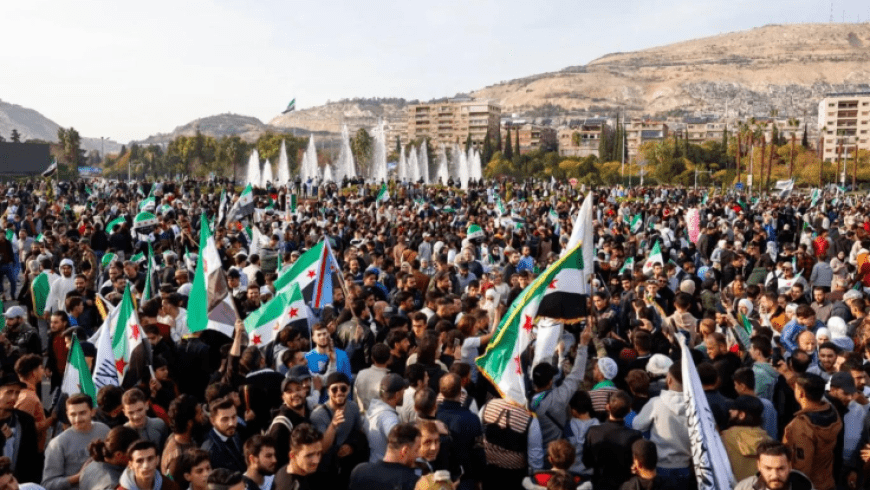
The Syrian government has issued the first official instrument regulating the right to peaceful assembly. The communiqué, issued by the Ministry of Interior in May 2026 on the basis of the Constitutional Declaration, is the first attempt by a Syrian government to treat public demonstration as a right subject to legal procedures rather than a security event to be suppressed.
For a country governed by emergency law from 1963 to 2011 — and whose security agencies continued to treat public assemblies as threats to the state even after that law was formally lifted, that is, throughout the period of the Syrian revolution — any regulatory framework recognizing the right to demonstrate is a departure from the logic of the former regime. The question, however, lies in the extent to which the framework chosen by the Ministry is consistent with the right it purports to protect.
The communiqué adopts a prior-authorization model: any group wishing to organize a demonstration must form a committee composed of a chair and at least two members, submit an application to the relevant governorate, and await a decision within five days. If no decision is issued, approval is deemed implicit. Refusals may be appealed before the administrative judiciary within one week. The Ministry undertakes to provide protection for licensed assemblies and prohibits the carrying of weapons. Assemblies held without a license are classified under Articles 335 to 338 of the Penal Code as riotous gatherings subject to criminal punishment. The Ministry also retains the authority to demand the dispersal of assemblies that exceed the terms of their license or breach public order, or to impose dispersal directly.
Before examining the specific shortcomings of the communiqué, it is necessary to address the argument that the security conditions in Syria justify a more restrictive regulatory model. The security environment is a tangible reality: the presence of unresolved local conflicts, the risk of retaliatory operations, and remnants of the former regime constitute direct threats to public safety. A degree of regulation, even if considered excessive in a stable state, may serve a legitimate protective function in this context, both for demonstrators and for the public. Nevertheless, the specific shortcomings addressed in this analysis are not the product of security necessity. The automatic criminalization of unauthorized assemblies, the absence of criteria for licensing decisions, the lack of guidelines on the use of force, and the exclusion of spontaneous assemblies are all regulatory choices, not security imperatives. None of them enhances operational security; rather, each restricts the exercise of the right without yielding any compensating security gain. These defects can be corrected within the existing institutional framework, and the security argument cannot justify them.
The core legal problem with the communiqué is its adoption of an authorization model rather than a notification model. UN Human Rights Committee General Comment No. 37 (2020) provides that the exercise of the right to peaceful assembly should not be subject to prior authorization. The most that may be permitted is a notification regime designed to enable the state to facilitate the assembly and protect public safety. The distinction here is conceptual rather than administrative: under a notification regime, the default is that the assembly may proceed; under an authorization regime, the default is that it may not proceed until the state grants permission.
A preliminary question nonetheless arises as to whether the communiqué possesses the legal authority to impose the restrictions it contains. Under international human rights law, restrictions on the right to peaceful assembly must be “prescribed by law,” a requirement set out in Article 21 of the International Covenant on Civil and Political Rights. This standard ordinarily requires a general legislative instrument adopted through a process that ensures sufficient precision, accessibility, and foreseeability. The ministerial communiqué, by contrast, is an administrative instrument rather than legislation: it is issued by a single ministry, can be amended or withdrawn without a legislative process, and lacks the formal characteristics of law in the traditional sense. Whether such an instrument satisfies the “prescribed by law” requirement is a question the framework itself does not address. If the restrictions imposed by the communiqué — including criminal referral under the Penal Code — rest on an administrative instrument that does not reach the threshold of “law” within the meaning of Article 21, the entire regulatory structure may lack a sufficient legal basis.
The requirement to form an organizing committee of at least a chair and two members before submitting a license application imposes a minimum threshold of prior organization. The numerical threshold is low and does not in itself constitute a significant obstacle. It does, however, tie the exercise of the right to a minimum degree of prior organization. General Comment No. 37, in paragraph 4, is explicit that an assembly need not be organized, and that individuals acting spontaneously also enjoy the right to peaceful assembly. A framework that requires the formation of a named committee with a designated chair before any application can be submitted excludes, by design, forms of assembly that lack a formal organizational structure. In a transitional context where political mobilization often occurs through informal coordination, this requirement narrows the scope of protected assembly beyond what international standards require. The problem is less the numerical threshold than the conceptual premise: that the right of assembly is available only to those who have first constituted themselves into an identifiable organizational unit subject to administrative — and potentially criminal — responsibility.
The delegation of licensing decisions to the governorates raises a further concern. The communiqué directs applications to the relevant governorate, which in turn refers them to a “competent committee” whose composition and decision-making criteria are not specified. Syrian governorates differ in their administrative capacity, political orientation, and security conditions. In some areas, the licensing process may operate with reasonable consistency; in others, it may turn into a mechanism of prevention. Without specifying clear grounds for refusal, requiring a written justification, or publishing decisions to enable public oversight, uniformity and political independence in licensing decisions cannot be guaranteed.
The treatment of spontaneous assemblies presents a separate problem. General Comment No. 37 recognizes spontaneous assemblies as a protected form of exercising the right to peaceful assembly. Political events that call for immediate popular expression — a government decision, a security incident, a judicial development — do not conform to administrative timetables. The five-day waiting period in the communiqué, even with implicit approval guaranteed in the event of administrative silence, prevents any immediate response to such events. The recommendation here is not to abandon regulation but to move from authorization to notification, with an explicit provision allowing demonstrations to proceed without prior notice when circumstances require immediate expression, provided they remain peaceful. A notification timetable adapted to Syrian conditions — for example, 48 to 72 hours — would be consistent with international standards while still accommodating legitimate security planning.
The most consequential provision of the communiqué is the classification of unauthorized assemblies as a form of rioting under Articles 335 to 338 of the Penal Code. These articles, which predate the current transitional framework, impose criminal penalties — including imprisonment — on participation in gatherings deemed to threaten public order. The communiqué creates an automatic legal equation between the absence of administrative authorization and the commission of a criminal act, without requiring that the assembly be coupled with violence or disorder. General Comment No. 37 addresses this directly: the failure to notify the authorities or to comply with regulatory requirements does not render the assembly unlawful, and should not serve as a basis for dispersal, arrest, or criminal punishment. If every unauthorized assembly is legally treated as a riot, security forces are granted a standing mandate to treat peaceful and spontaneous gatherings as criminal events. This eliminates the legal distinction between protest and disorder — a distinction essential to any transitional framework that seeks to build public confidence in state institutions. The state may legitimately impose proportionate administrative penalties for deliberate non-compliance with reasonable notification requirements, but what it may not do is equate the mere absence of authorization with rioting. What is required is a graduated framework: administrative penalties for deliberate failure to notify when notification is feasible, with criminal liability confined to cases of actual violence or serious disturbance.
The communiqué’s provisions on terminating assemblies reveal a related gap. The Ministry may request the organizing committee to end a demonstration if it exceeds the terms of its license or if acts occur that would “breach public order or obstruct the authorities in the performance of their duties.” If the committee does not comply, the Ministry may disperse the assembly directly. The communiqué offers no guidance on how dispersal is to be carried out, the permissible level of force, requirements for a graduated response, or the accountability of security personnel in cases of excessive use of force. Ministerial instructions integrating the UN Basic Principles on the Use of Force and Firearms would provide a practical first step, grounded in the use of force as a last resort, proportionality to the actual threat, an absolute prohibition on the use of lethal force in crowd dispersal, and individual accountability for violations.
The communiqué also omits any provision addressing counter-demonstrations or the state’s obligation to protect assemblies from hostile third parties. In Syria’s current environment, where sectarian and political tensions remain acute, assemblies are vulnerable not only to state interference but also to disruption by opposing groups. International human rights law imposes on the state an obligation that goes beyond refraining from interference with peaceful assembly; it includes taking reasonable steps to protect participants from violence by non-state actors.
In conclusion, the gap between the communiqué’s procedural innovations and its conceptual framework is the central tension this framework must resolve. The procedural components demonstrate that the Syrian government possesses the administrative capacity to regulate public assembly through legal channels. The question is whether it will use that capacity to facilitate the exercise of the right or to control access to it.