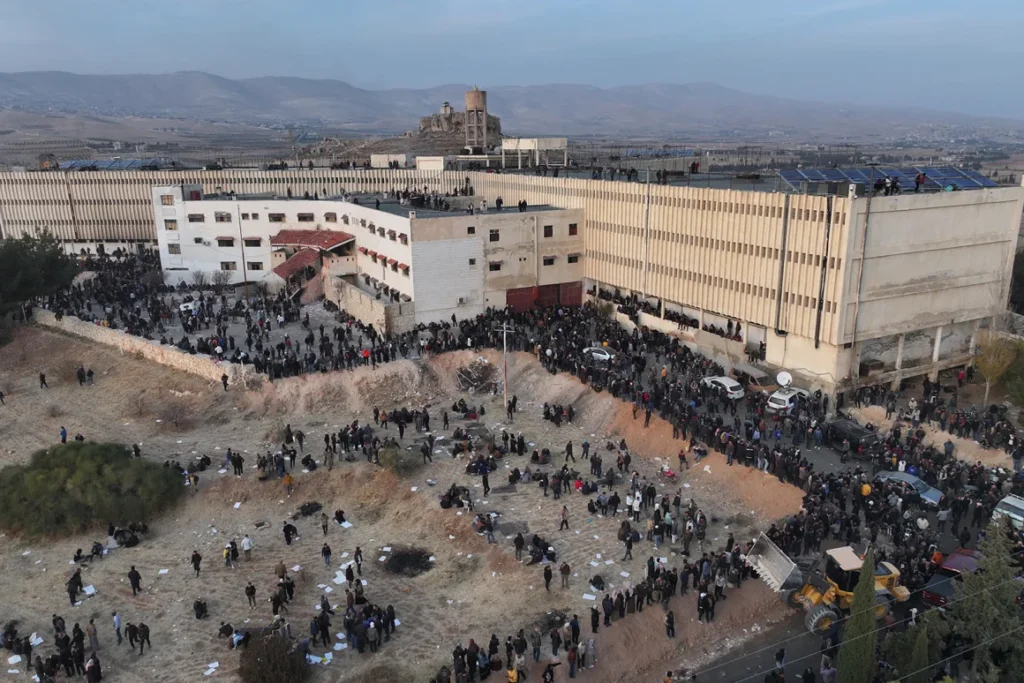
In this article, I demonstrate that the recordings leaked from Saydnaya Prison and Tishreen Military Hospital, despite the great importance of their content, have become threatened in their legal and evidentiary value as a result of their random public circulation without passing through any recognized chain of custody. These materials intersect with three interlocking legal frameworks: international criminal law, international humanitarian law, and digital evidence law, which makes their unregulated circulation an evidentiary risk that undermines future judicial pathways. Furthermore, the retention of evidence relating to international atrocities outside official channels may entail potential legal consequences that could amount to obstruction of justice under Article 70 of the Rome Statute, while uncoordinated publication causes severe humanitarian harm to the families of the missing. The article concludes that the responsible handling of these materials requires two parallel tracks, not a choice between publication and concealment: official documentation through competent international investigative bodies, and media publication subject to verification standards and the protection of victims’ identities — because the distinction between what the public has seen and what a court can use is the decisive line governing this matter.
Fadel Abdulghany
The recordings leaked from Saydnaya Prison and Tishreen Military Hospital have entered public circulation without passing through any recognized chain of custody, having been published by parties of unknown identity. Three legal frameworks intersect with respect to these recordings: international criminal law, because the sites in question are places where crimes against humanity and war crimes were committed; international humanitarian law, because the victims were detained without basic legal guarantees; and digital evidence law, because the recordings may constitute potential digital testimony.
The convergence of these frameworks on the same material means that unregulated circulation threatens to undermine its usefulness in any future legal proceedings. The argument made here is that there must be no conflation between leaked materials and legally provable evidence, and that responsible engagement with them requires two parallel tracks: official documentation through competent investigative bodies, and responsible media publication subject to verification standards and the protection of victims.
The first risk is evidentiary. The value of digital evidence in criminal proceedings does not depend on its content alone, but on its verifiability and on the documentation of its chain of custody. When an individual leaks a hard drive, hands a copy to the Ministry of Interior for example, and retains a personal copy for publication, the chain of custody has effectively broken down. There is no documentation that establishes when the videos were recorded, nor any guarantee preventing the possibility of alteration or forgery, and without that chain, these recordings are likely to be treated as indicative materials rather than as independent evidence.
The second risk is legal. The retention of evidence of international crimes outside official channels increases the likelihood of accountability under multiple frameworks. Under international criminal law, withholding evidence from the competent authorities may rise to the level of obstruction of justice if it occurs intentionally or leads to partial destruction of the evidentiary record. If it can be established that an individual retained the materials and then edited or deleted parts of them prior to publication, this may constitute tampering with evidence under Article 70(1)(c) of the Rome Statute, which criminalizes intentional obstruction of the proceedings of the International Criminal Court. The general principle holds: the unregulated retention and selective publication of materials linked to mass atrocities may form a basis for criminal responsibility under international law, regardless of the holder’s intent.
The third risk is humanitarian. Article 19(3) permits the imposition of restrictions to protect the rights of others and public order against arbitrary media publication, and the ethical framework for documenting human rights violations imposes additional restrictions here. The principles of “do no harm” require striking a balance between the public interest in disclosure and the risks of re-traumatizing victims and their families, or exposing survivors to security threats if information identifying them is revealed.
In the Syrian context, estimates by the Syrian Network for Human Rights indicate that tens of thousands of families still do not know the fate of their relatives. Proceeding from this, the publication of materials without coordination may lead to a family member learning of a relative’s death through a clip circulated on social media, without any preparation or psychological and social support. Under the standard of “do no harm,” this does not count as a contribution to revealing the truth, but rather as a violation of human dignity — and that is precisely what the legal framework was created to prevent.
The unregulated circulation of these materials is exacerbated by the role of social media platforms, which amplify circulation without applying any verification, refinement, or contextualization. Once the recordings enter these channels, neither investigative bodies nor families remain able to control how, when, or in what form these materials are encountered. Circulation through the platforms specifically accelerates the very harms that the “do no harm” framework was designed to prevent, and it does so on a scale that no subsequent rights-based correction can undo.
Accordingly, the argument is not a binary choice. The question is not publication or concealment, but how the material is handled so that it serves both accountability and protection. The standard adopted in international human rights practice for documenting violations rests on three conditions: verifying the authenticity of the material before publication, concealing information that identifies victims unless explicit and informed consent is obtained, and consulting with psychosocial support organizations regarding the context of presentation. Materials that meet these conditions can be published responsibly; materials that do not meet them should not be treated as ready for circulation.
Translating this analytical framework into institutional practice requires work along two parallel tracks. The first is the track of UN documentation: handing over complete and unredacted copies to the competent investigative bodies, such as the Independent Investigative Mechanism of the United Nations or the International Commission of Inquiry, or trusted human rights organizations.
On the governmental side, the response must focus on preserving the chain of custody and protecting victims. Individuals who hold original copies should be directed to hand them over to the competent authorities, accompanied by a written statement explaining the circumstances of obtaining them, while keeping the files unaltered and preserving their metadata intact.
The Criminal Security Directorate and the judicial police must preserve the circulating materials in accordance with chain-of-custody standards, including the extraction of metadata and documentation of the path by which each file was obtained. Personnel appearing in the recordings should also be matched against employment records, and anyone whose involvement is established should be detained. Families must be notified through official channels, in coordination with the Commission on the Missing and the competent Syrian human rights organizations.
The Saydnaya and Tishreen Hospital recordings are potential evidence of crimes under international law, and the manner in which they are handled will determine whether they will contribute to the achievement of justice or complicate it. The distinction between what the public has seen and what a court can use remains the governing analytical line. Disclosure without verification, possession without independence, and circulation without protection do not produce accountability — they produce an appearance of evidence after its legal substance has been compromised.