I show in this article that the mine-removal operations Israel is carrying out along its borders with southern Syria, through massive commercial contracts with American defense companies, are not a security measure but rather a core element in a strategy of gradual regional entrenchment that Israel has been working to consolidate since the fall of the Assad regime in December 2024. The article reveals three interlocking dimensions of this strategy: the first is the commercial-military dimension, embodied in mine-removal contracts whose value exceeds $60 million and which are tied to a border-barrier project whose cost reaches $1.7 billion; the second is the military deployment on the ground, through the establishment of forward bases in the Quneitra and Daraa governorates and the carrying out of repeated incursions inside the buffer zone; and the third is the legal and political packaging of the operation as a humanitarian activity, in a manner that serves the de facto occupation without triggering international reactions. The article concludes that this pattern rises to what can legally be described as “creeping annexation,” and that the absence of a coordinated international response is itself part of the structure that enables this strategy to move forward.
Fadel Abdulghany
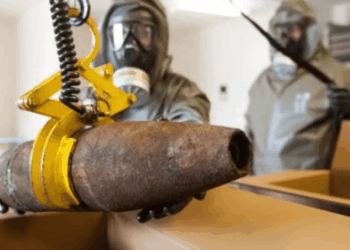
Israel is using mine-removal operations — carried out through commercial contracts along its “borders” with Syria — as a preliminary step within a strategy to entrench regional control. What the occupation army officially presents as a security measure to protect border towns represents, in its essence and in terms of scope, institutional context, and chronological sequence, a component of an expanding military infrastructure aimed at entrenching Israeli control over territory in southern Syria. The evidence supporting this conclusion is conclusive, and rests on multiple (and converging) tracks of activity Israel has pursued since the fall of the Assad regime in December 2024. The commercial dimension of this strategy has now become well documented; in February and March 2026, “Ondas Holdings” announced that its subsidiary “4M Defense” had received an initial order worth $15.8 million under a mine-removal contract worth $30 million, covering nearly 741 acres along the Israeli-Syrian border. In April 2026, this was followed by the announcement of another initial order worth $10 million under a separate mine-removal program worth $50 million, tied to the Israeli “Eastern Border Security Barrier” whose cost reaches $1.7 billion. The value of the joint program concerning the Syrian border component alone may reach $60 million. Implementation relies on autonomous ground robots, drones, and AI-driven sensor platforms, operated under a contract with a company listed in the United States.
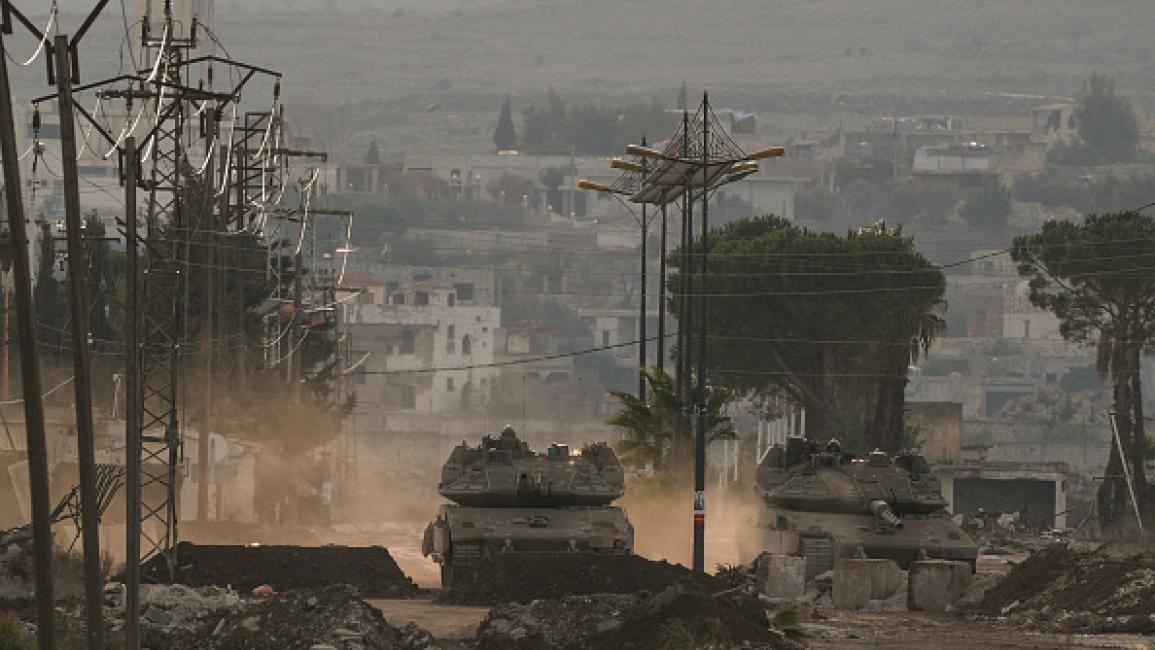
These contracts are not separable from the “Eastern Border Security Barrier,” officially launched by Security Minister Israel Katz in March 2025. This barrier is a multi-layered system that includes physical fences, radars, cameras, and intelligence sensors, extending about 500 kilometers from the occupied Golan Heights through the West Bank down to the area north of Eilat. The Israeli Defense Ministry describes its purpose as reinforcing strategic control over the eastern border. The removal of mines from contaminated lands along the Israeli-Syrian border is a precondition for the construction of this barrier and for the forward military positioning that accompanies it. In the same area, Israel has established a substantial military footprint inside Syrian territory. In the aftermath of the collapse of the Assad government, Israeli forces stormed the demilitarized buffer zone established under the 1974 disengagement agreement. By mid-2025, satellite imagery confirmed the presence of at least six military bases inside the zone. By July 2025, reports indicated the existence of ten Israeli bases in the Quneitra and Daraa governorates in southern Syria. Incursions into villages in the two governorates continued until April 2026, as IDF vehicles entered homes, detained civilians, and positioned themselves inside residential clusters. The barrier, the bases, and the mine removal are nothing but components of a single regional strategy, and any treatment of any one of them in isolation from the others distorts the reality of its function. Israel is following an approach of gradual regional entrenchment rather than proceeding with a single formal annexation. Netanyahu has stated that Israel will continue to retain, develop, and settle the Golan. It has also announced plans to double the number of settlers in the occupied Golan Heights. This language, and the settlement activity that accompanies it, follows a familiar pattern in the West Bank, where decades of gradual expansion preceded steps of formal annexation. Likewise, the Israeli demands of the post-Assad Syrian government rest on the logic of the “buffer zone,” which by its very nature entails physical control over Syrian territory. An analysis by the Carnegie Endowment for International Peace reports that Israel has pushed for the establishment of a demilitarized zone extending from Damascus to the Golan, forced Syrian forces to withdraw their heavy weapons from the south, and established forward positions to enforce this coerced withdrawal. This pattern can be described as “creeping annexation,” because Israeli forces have advanced several kilometers into southern Syria, destroyed homes, and bulldozed land. This term is a legal characterization, not merely a rhetorical label, in that it describes a process of expansion in which an occupying power extends its effective control through cumulative steps that, each on its own, appear limited in effect, but which together constitute a permanent seizure of land. In this context, the mine-removal operation performs at least three functions that go beyond the declared security justification. First, it opens the land for the construction of the barrier and for potential settlement expansion. Second, it enables the smooth movement of Israeli military vehicles and forces deployed at forward positions inside the buffer zone and along it. Third, it provides a politically defensible framework, in that mine removal is officially classified as a humanitarian activity under the framework of the Ottawa Convention, even when an occupying power carries it out for purposes connected to force projection. Israel is not a party to the Ottawa Convention, and this removes one of the layers of legal accountability. The commercial packaging of the operation through a U.S.-listed defense contractor compounds this effect; for by routing a military activity through a commercial procurement mechanism, the operation acquires a procedural appearance as a technology contract, not as a territorial occupation operation. Thus regulatory disclosures, press releases, and stock-price movements come to replace the vocabulary of occupation with the vocabulary of the market. The relevant legal framework includes the 1974 Disengagement Agreement, the law of belligerent occupation as codified in the Hague Regulations and the Fourth Geneva Convention, the prohibition on the acquisition of territory by force under Article 2(4) of the UN Charter, and Security Council Resolution 497 of 1981, which declared Israel’s purported annexation of the Golan null and void. Netanyahu has claimed that the 1974 agreement is no longer valid following the change of government in Damascus — a position that lacks legal foundation. For under the law of state succession, treaties of a territorial or boundary character — including armistice and disengagement agreements tied to specific territory — are generally binding on successor states, regardless of governmental changes. The 1978 Vienna Convention on Succession of States in Respect of Treaties reflects this principle, which is a principle firmly established in customary international law. Accordingly, Israel’s occupation of the buffer zone violates an agreement that remains in force. The construction of permanent infrastructure inside that zone — barriers, military bases, and sensor arrays — raises a further legal question: at what point does a military presence cross the threshold of temporary belligerent occupation to become conduct rising to the level of annexation? For under the law of occupation, an occupying power is bound to preserve the existing status quo, and is prohibited from making permanent changes in the occupied territory serving its own sovereign interests rather than the welfare of the population living under occupation. The duration of the presence, the nature of the infrastructure — whether temporary or permanent — and the declared intent of the occupying power… all are criteria relevant to this assessment. In light of each of these criteria, Israeli conduct in the buffer zone, and in the Golan, points toward annexation, not toward a mere temporary security deployment.
It is true that the mines along the Golan borders constitute real dangers to the neighboring communities, and that mine removal, in principle, is a legitimate and beneficial activity. However, the scale of the program — $60 million for the Syrian border component alone, within a barrier project whose cost reaches $1.7 billion — far exceeds what a local preventive measure would require. The geographic scope, too, which covers 741 acres along a line of contact on which Israel is, at the same time, building military bases and expanding settlements, reinforces this conclusion. As for the institutional context, it is a context in which the occupying power has explicitly declared its intent to retain, develop, and settle the territory in question. Therefore, a purely defensive reading of the mine-removal program is not sufficient to explain these realities. And the absence of an effective international reaction is itself part of the structure that enables this strategy. For the United Nations Security Council, constrained by the dynamics of the “veto,” has not acted in the face of the violations of the 1974 agreement or of Resolution 497. UNDOF, the force tasked with monitoring the disengagement zone, has also been operationally marginalized. Nor have the states neighboring Israel developed a coordinated diplomatic challenge. Each individual step within the Israeli regional program — a mine-removal contract here, a forward base there, a settlement-expansion announcement — has been calibrated to remain below the threshold that might call for collective action. Accumulation is the essence of this strategy, and this calls for active Arab and international action. The trajectory is clear: a forward military presence, permanent infrastructure, settlement expansion, and repeated incursions and arrests in Quneitra and Daraa, supported now by commercially contracted robotic mine-removal operations. This is not merely a defensive reinforcement of existing positions, but a gradual regional entrenchment in southern Syria, formulated through steps that together constitute a coherent program. The commercial and technological packaging of the mine-removal program does not change its strategic function — occupation/annexation; rather, it serves it.