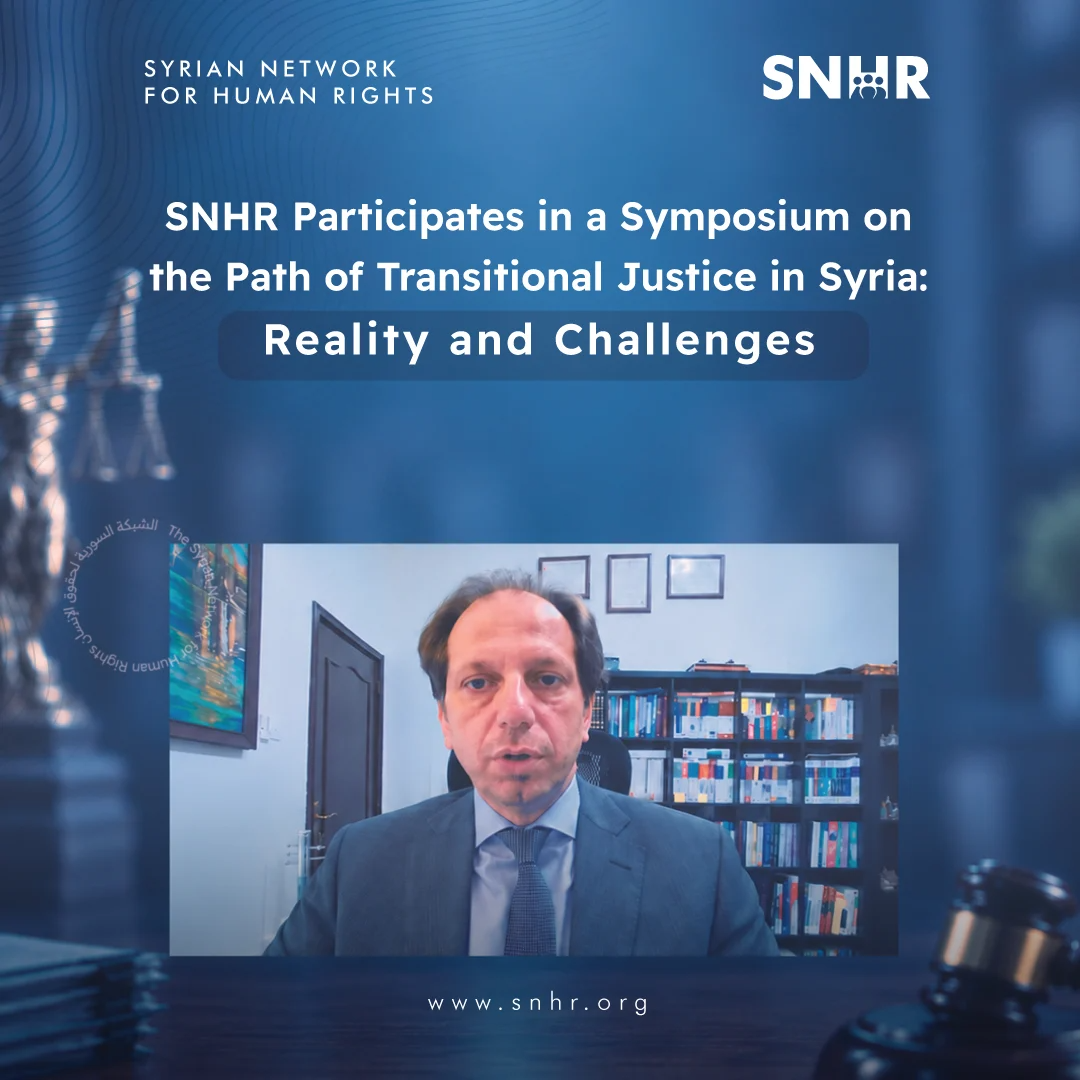
The Syrian Network for Human Rights (SNHR), represented by its Executive Director Fadel Abdulghany, took part in a symposium entitled The Path of Transitional Justice in Syria: Reality and Challenges, which was held online and organized by تيار العروبيين السوريين (the Syrian Arabian Current) on September 1, 2026.
During the symposium, Mr. Fadel Abdulghany delivered a keynote intervention, which was followed by a session of questions and discussion, and the symposium was divided over three themes: the reality of transitional justice in Syria today, the obstacles it faces, and the role of civil society and of the political elites.
Abdulghany pointed out that the question on the table is no longer whether transitional justice has begun in Syria, for it has in fact begun, but rather whether the measures taken at present are maturing into an integrated system capable of achieving the disclosure of the truth, accountability, reparations, and guarantees of non-recurrence under the rule of law. He warned of two opposite errors: regarding the path as purely symbolic, on the one hand, and treating the establishment of bodies and the start of trials as evidence that transitional justice has been achieved, on the other. He showed that Syria is still at an early stage of implementation, for the path has moved from political commitment to constitutional recognition and then to institution-building and judicial work, however it hasn’t yet turned into a comprehensive national system with a stable legal framework, capable of producing tangible results in all of the main areas of transitional justice.
Mr. Abdulghany reviewed what has been achieved so far, including: the explicit treatment of transitional justice in the Constitutional Declaration, the establishment of two national bodies, one for transitional justice and one for the missing, the creation of specialized chambers and the appointment of their members, the preparation of a draft transitional justice law that hasn’t yet entered into force, the arrival of national criminal proceedings at the stage of issuing judgments, the work of the United Nations mechanisms from inside Syria, the movement on the file of the missing, and the formation of new parliamentary committees concerned with transitional justice and with human rights.
He pointed to some matters that are still pending, such as who is covered by transitional justice and whether all victims are included, how the scope of the violations is to be dealt with, the possibility of trying international crimes before the national courts in a manner that respects the principle of legality, the extent of the transparency and procedural precision involved in the ongoing trials, how information is to be exchanged between the institutions concerned with the missing, the criminal investigation bodies, and the documentation organizations, without prejudice to consent, confidentiality, and the integrity of the evidence, and the absence of a national reparations program along with the absence of the institutional reforms that must accompany the trials.
Abdulghany stressed that transitional justice isn’t reduced to criminal prosecution, for the courts are the most powerful tools of accountability, however they can’t on their own reveal the fate of hundreds of thousands of missing persons, nor design a national reparations program, nor reform the security institutions, nor preserve the archives, nor build guarantees of non-recurrence. Individual criminal responsibility, moreover, differs from the responsibility of the State and its obligations, and since the trials are reaching the official positions that the accused had held, which is what calls for establishing the broader context of war crimes and crimes against humanity, the obligations of the State therefore pass to the successor government in accordance with international law, so it follows that the duty of prosecution, of revealing the fate of the missing, and of addressing the chemical weapons file falls upon the current authorities, even if the violations were committed under the Assad regime.
He added that the trials began quickly, before the Syrian institutions were ready, and this is what led to the occurrence of procedural errors, since trials of this complexity are usually preceded by four to six months of consultation on the legal framework of the court. Criticism is welcome, but it ought to be framed in a way that fortifies the trials rather than brings them down, because their failure would be catastrophic. As for the death penalty, Abdulghany was of the view that it is better to retain it while narrowing its scope, so that it is confined to the senior war criminals and the perpetrators of crimes against humanity, and within a defined period, not to ordinary criminals.
In the conclusion of his intervention, Abdulghany explained that transitional periods are among the most difficult subjects of political science, because they fall between conflict and stability, and this is what makes them highly ambiguous. He also emphasized the centrality of the role of civil society, because the authorities that arrive through a military victory after an armed conflict carry a deficit in legitimacy that must be repaired through the civil institutions. And since a large part of civil society is what preserved the evidence in the previous stage, it ought to be present today at the junctures of the political transition: the national dialogue, the Constitutional Declaration, the expert committees, the investigation committees, and the design of the legislative council, alongside its contribution to research, monitoring, and evaluation. Within this framework, SNHR has shared its data with the courts, provides advice to state institutions in the field of institutional reform, and has published visions for the political transition, for transitional justice, and for the design of the legislative council.