In this article, I lay out the dual nature of the in absentia trial currently underway before the Fourth Criminal Court in Damascus against Bashar al-Assad and eight other defendants. I discuss the meaning of an in absentia trial and its legal and political limits, setting aside the recurring question of the court’s institutional legitimacy. The article’s central argument is built on the idea that Assad’s physical absence from the dock doesn’t strip the trial of its value, but rather redefines that value. At this stage, the trial won’t lead to the execution of an actual sentence, however it is capable of producing an official Syrian judicial record containing established facts, criminal characterizations, and a documented chain of responsibility, a record that retains its weight after these proceedings conclude, and contributes to future accountability tracks. I raise three legal points in the article: the first is that Syrian law permits trial in absentia subject to specific constraints, however the in absentia judgment remains susceptible to being voided and the trial reopened if the defendant later appears, which makes the real value of the judgment lie in its being a provisional record rather than a final sentence. The second is that the validity of these proceedings requires meeting the conditions of a fair trial under the International Covenant on Civil and Political Rights and General Comment No. 32 of the Human Rights Committee, particularly adequate notification of the defendant and proof of the voluntariness of his absence. The third is that the in absentia judgment has a significant material effect relating to the defendant’s movable and immovable assets, which may in the future allow linking them to a reparations track for the benefit of victims. The article concludes that the value of this trial is conditional: if it produces a procedurally precise and legally transparent record, it transforms into a foundational document in the path of Syrian justice; and if the record remains incomplete or muddled, it will remain a symbolic event whose impact doesn’t exceed its image.
Fadel Abdulghany
The proceedings currently underway before the Fourth Criminal Court in Damascus against Bashar al-Assad and eight other defendants are being held in the absence of a number of them, and at the forefront of these is Assad himself. This article doesn’t address the judicial basis of the court or its institutional nature, as that was discussed in a previous article, but rather focuses on the meaning of an in absentia trial and its legal and political limits.
Bashar al-Assad is a fugitive from justice, enjoys Russian protection, and there doesn’t appear to be any realistic near-term prospect of his extradition or arrest. Therefore, these proceedings, at their current stage, will not lead to actually punishing him or bringing him before the courts. However, their importance doesn’t lie in this aspect alone. What this trial can produce is an official judicial record, issued by a Syrian court, containing established facts, legal characterizations, and a documented chain of criminal responsibility, allowing this record to retain its weight after the current trial ends, and to contribute to future accountability efforts.
Syria has never before witnessed criminal proceedings of this kind against senior officials accused of responsibility for systematic violations. As for the millions of victims, survivors, and families of the disappeared and the dead, the trial, even while in absentia, carries great symbolic value; it moves Assad from the position of former president and holder of absolute power to the position of a defendant before the Syrian judiciary.
National law provides a procedural basis for trying a fugitive defendant in absentia. So it follows that trial in absentia is permissible in specific cases if the defendant was duly summoned and did not appear, and the crime was among those carrying a serious penalty. However, the in absentia judgment, in this context, is not considered a final, non-reviewable judgment. For national law allows the in absentia judgment to be voided and the trial reopened if the convicted person turns himself in or is arrested.
Thus, the value of the in absentia judgment isn’t in its being a final sentence, but rather in its being a provisional judicial record, in force until the defendant appears and is retried. Legal analyses of national law indicate that the in absentia judgment against a fugitive also produces an effect on his assets, through their administration in accordance with the rules governing the assets of an absent party.
Hence, these proceedings must be evaluated against a specific standard: not the extent of their capacity to execute the sentence now, but rather the extent of their capacity to produce an impartial and durable judicial record. So if Assad’s presence is not possible at this stage, then the presence of the law must be clear and complete.
Reliance on national procedural legislation alone is not sufficient in this domain. For trial in absentia, even when permitted by national law, remains constrained by fair trial guarantees. So the International Covenant on Civil and Political Rights guarantees the defendant’s right to be tried in his presence, while General Comment No. 32 of the Human Rights Committee does not absolutely exclude in absentia trials, but rather conditions their legitimacy on essential requirements: prior and adequate notification of the defendant, proof that his absence was voluntary, and guaranteeing his right to a retrial if he later appears or is arrested.
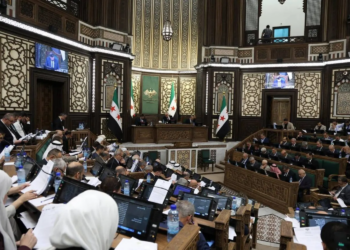
In the session of 10 May, the presiding judge confirmed that the notification orders had been served “in accordance with procedure” at the last known place of residence of the defendants, and that they had not complied with the summons. However, the available public records don’t adequately clarify all the means of notification used. It appears that some of them were carried out via publication or through indirect channels. The public prosecution is required to take reasonable steps to notify each defendant, in an actual and adequate manner, of the proceedings underway against him. The more detailed the notification record is, the more capable the in absentia judgment becomes of withstanding challenge, and the less susceptible it becomes to criticism.
Likewise, the effect of the in absentia judgment is not limited to the symbolic dimension or the legal record. So one of the important practical outcomes relates to the assets of the person convicted in absentia. For national law allows placing the movable and immovable assets of the fugitive defendant under legal administration, in a way that prevents him from disposing of them until the in absentia judgment is voided or the trial is reopened. So the trial of Assad doesn’t merely touch his political and symbolic image, but may also touch the material structure of the power he accumulated. And if the assets file is managed with legal guarantees, it may constitute a subsequent gateway for linking the administered or seized assets to victims’ rights and reparations, rather than the matter remaining a mere isolated administrative procedure.
In the end, the importance of trying Assad in absentia doesn’t lie in its direct capacity to punish him now. For Assad is absent, and the in absentia judgment is susceptible to being voided and the trial reopened if he appears before the courts. But the real value of this trial lies in two things: that it produces a Syrian judicial record concerning the crimes attributed to the head of the former regime, and that it affirms that the fall of authority doesn’t mean the fall of the right to accountability.
For this reason, the trial’s symbolism is large, but it is not sufficient on its own. So symbolism needs legal grounding, the judicial record needs procedural precision, and the judgment’s effect on assets needs transparent administration disciplined by the law. So if the court succeeds in this, the trial of Assad may transform from an in absentia procedure of limited execution into a foundational document in the path of Syrian justice. As for the case where the record remains incomplete or muddled, the trial will remain an event significant in its image, limited in its impact.