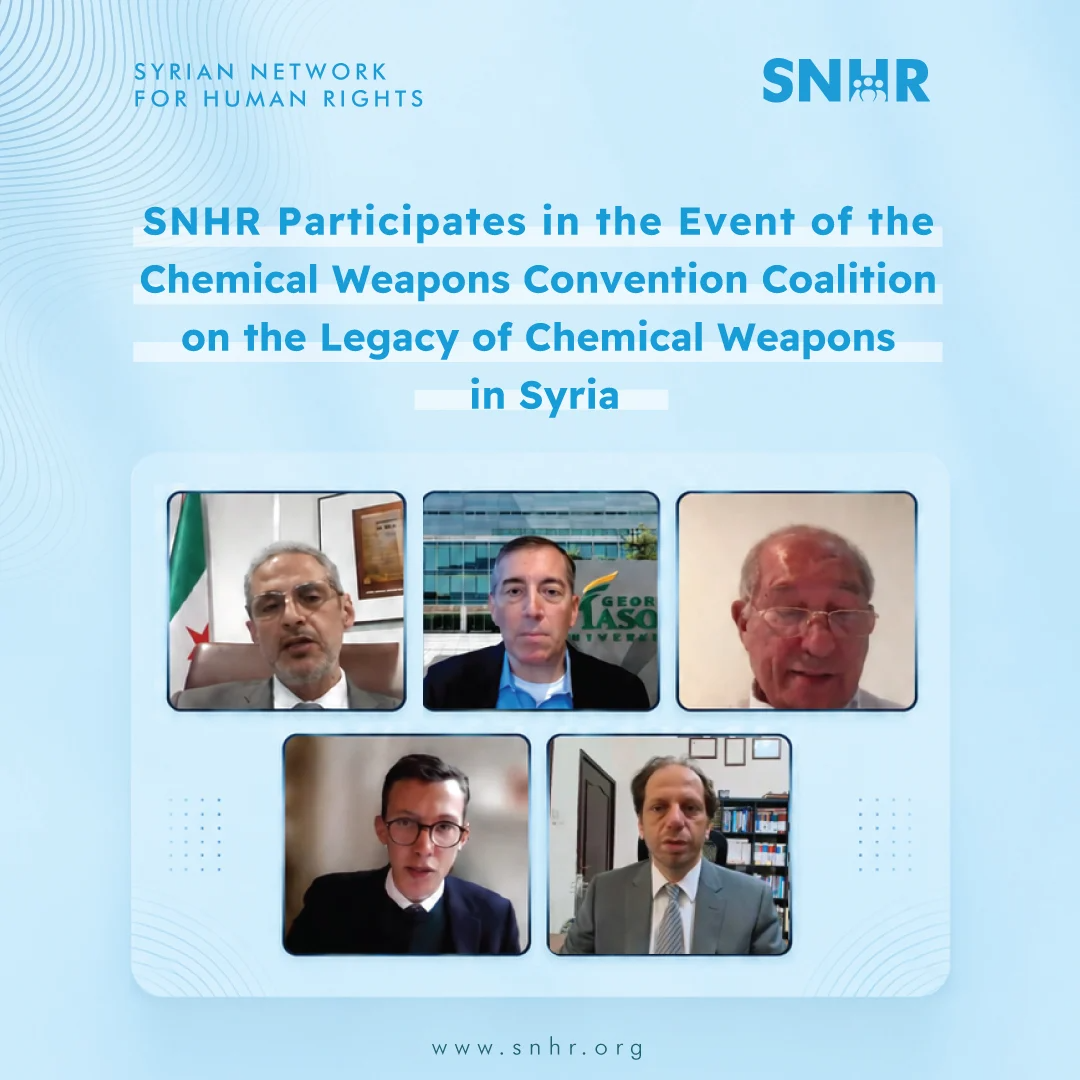
Executive Director of the Syrian Network for Human Rights (SNHR), Fadel Abdulghany, participated on September 16, 2026, in an online event titled Syria’s Chemical Weapons Legacy: Current Issues and Challenges, organized by the Arms Control Association and the Chemical Weapons Convention (CWC) Coalition. The event addressed the efforts of Syria, in cooperation with the Organisation for the Prohibition of Chemical Weapons (OPCW) and the international community, to account for and destroy what remains of the Assad-era chemical weapons arsenal, to assist the victims, and to hold the perpetrators of violations accountable.
The briefing was moderated by Gregory D. Koblentz, Associate Professor and Director of the Biodefense Graduate Program at the Schar School of Policy and Government at George Mason University, and it included a keynote address by the Ambassador Mohamad Katoub, the Permanent Representative of Syria to the OPCW, in addition to interventions by Ahmet Üzümcü, the former Director-General of the OPCW, Richard Yates, the Deputy Permanent Representative of the United Kingdom to the OPCW, and Mr. Fadel Abdulghany.
The Ambassador Katoub pointed to three main challenges facing the destruction efforts: the clandestine nature of the program inherited from the former regime, the limited capacities of the national institutions, and the security risks. He stated that the remnants found in May had been consolidated, and that the destruction of 42 unfilled aerial bombs began in August, adding that 18 former officers and chemical experts are in detention, and that investigations have been opened into two attacks, even though Syrian law does not yet criminalize the use of chemical weapons. For his part, the Ambassador Üzümcü reviewed the work of the OPCW in Syria since 2013, starting from the removal of approximately 1,300 metric tons of declared chemical agents and precursors, through to the Fact-Finding Mission (FFM), the OPCW-UN Joint Investigative Mechanism (JIM), and the Investigation and Identification Team (IIT), noting that only seven of the 26 outstanding issues related to the declaration were resolved under Assad, while the new authorities have granted full access. As for Mr. Yates, he spoke about the Syria-led “Breath of Freedom” Task Force and its seven tracks, noting that the United Kingdom has provided more than £3.5 million to the OPCW Syria Missions Trust Fund, and more than £7 million for destruction operations.
In his speech, which was titled From Documentation to Fair Trial: Turning Evidence into Individual Criminal Responsibility for Chemical Weapons Crimes in Syria, Mr. Abdulghany focused on accountability, specifically on how to turn the record that Syria possesses today, alongside the international record that has been built over the past decade, into lawful, fair, and individual criminal cases. He stressed that the problem of Syria does not lie in a lack of documentation, but rather in the task of turning a massive, yet fragmented, record into suspect-specific cases that are capable of withstanding trial and appeal.
Mr. Abdulghany noted that SNHR has documented 222 chemical weapons attacks in Syria between December 23, 2012, and December 8, 2024, 217 of which were carried out by the Assad regime forces, while ISIS carried out five attacks. The attacks of the Assad regime forces killed 1,514 individuals and injured more than 11,000 others, while the attacks of ISIS injured 132 other individuals.
He stressed that proving guilt in Syrian national judicial proceedings is the task of an independent prosecution service and an independent judiciary, while competent foreign courts retain a parallel role wherever a legal basis exists for them, citing the universal jurisdiction cases and the judicial proceedings in France against Bashar al-Assad. In this context, he explained that SNHR has contributed to all of the cases brought before the courts in Syria, including the trials of Atef Najib, Wassim al-Assad, and Ahmad Badreddin Hassoun.
Mr. Abdulghany added that SNHR provides structured materials that help prosecutors to open, prioritize, and direct their investigations, including incident chronologies, records of the victims and the injured, source matrices, leads for reaching witnesses, and an explicit statement of where the evidence is weak. He explained that, for these materials to be usable, a distinction must be drawn between what has been independently verified, what is a documented allegation, what is a conclusion of SNHR’s own, and what remains merely an initial lead. As for the prosecutors, they must independently assess the authenticity, reliability, and relevance of the materials, determine whether further corroborating evidence is needed, and leave the questions of admissibility and probative weight to the court.